

Carmién » News »
How to Choose the Right Rooibos Cut Size for Your Application: A Procurement Guide
How to Choose the Right Rooibos Cut Size for Your Application: A Procurement Guide
15 July 2026
Excerpt:
Learn how Rooibos cut size influences manufacturing performance, extraction efficiency, flavour and application to select the ideal grade for teabags, loose-leaf, RTDs, espresso, extracts and functional ingredients.

When sourcing bulk Rooibos, procurement teams typically compare suppliers on origin, certifications, price and supply security. While these are all critical considerations, one technical specification can have an equally significant impact on the success of the finished product: cut size.
Particle size distribution influences far more than appearance. It affects manufacturing performance, filling efficiency, infusion time, extraction efficiency, flavour development, mouthfeel and ultimately the consumer experience. Selecting the correct grade can improve production consistency, optimise ingredient usage and help deliver the cup profile your customers expect.
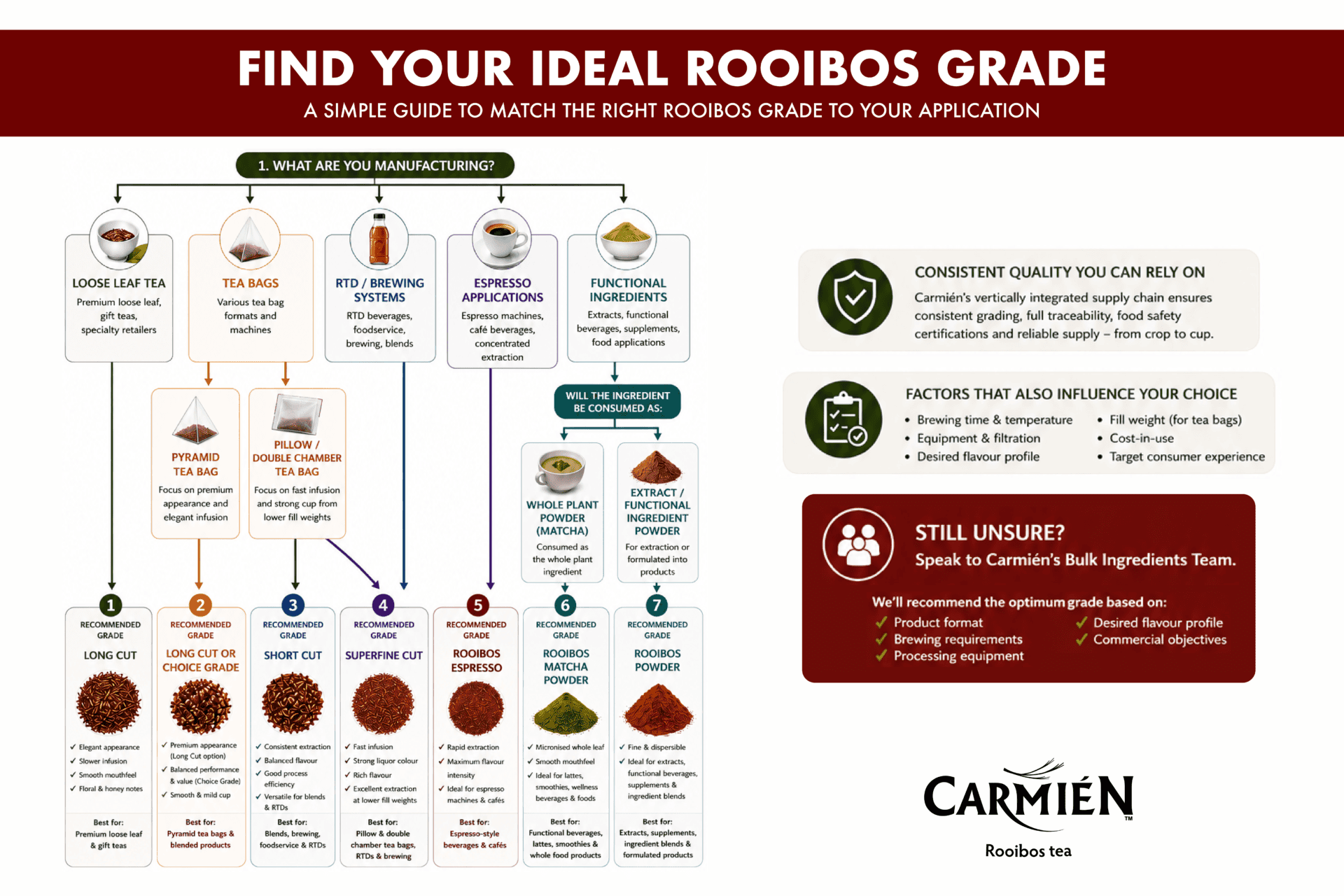
At Carmién, we offer a comprehensive range of Rooibos grades developed for different manufacturing processes and applications, from premium loose-leaf teas and high-speed teabag production to ready-to-drink beverages, espresso-style products and functional ingredient formulations. Understanding how cut size influences performance is the first step towards selecting the best grade for your application.
🔍 Click to enlarge
Why cut size matters
When selecting bulk Rooibos, the first question should not be “Which cut size has the strongest flavour?” It should be “What application is this Rooibos intended for?”
Every manufacturing process places different demands on the ingredient. A premium loose-leaf tea requires visual appeal and a slower, more elegant infusion, while conventional pillow teabags often come with density requirements to enable packing on high-speed machines. Double-chamber teabags need rapid extraction to deliver a full-flavoured cup despite their lower fill weights, and Pyramid teabags require a balance between appearance and brewing performance, whereas RTD beverages, espresso-style products, extracts and functional ingredient applications each have their own processing requirements.
Choosing the correct particle size distribution helps optimise manufacturing performance, filling efficiency, infusion time, extraction efficiency, finished product consistency and, ultimately, the sensory experience delivered to the consumer.
Once the application has been identified, particle size distribution becomes an important technical consideration because it influences both manufacturing performance and the sensory profile of the finished product. Rather than offering a single “best” grade, Carmién provides a portfolio of Rooibos grades developed for specific applications, enabling manufacturers to select the most appropriate solution for their production process.
How cut size influences extraction and flavour
As particle size becomes finer, the total surface area exposed to water increases. This allows water to penetrate the plant material more rapidly, accelerating the extraction of colour, aroma and flavour compounds (Astill et al., 2001).
In practical terms, finer grades produce faster colour development, stronger flavour release and improved extraction efficiency within standard brewing times. Coarser grades extract more gradually, producing a lighter, more delicate infusion that continues to develop over a longer brewing period.
Particle size distribution also influences the natural balance between leaf and stem. Finer grades generally contain a higher proportion of leaf material, while coarser grades contain relatively more stem. This distinction influences the sensory profile of the finished cup. Leaf-rich grades are generally associated with more pronounced fruity and spicy notes, together with greater body and a slightly firmer finish. Stem-rich grades typically emphasise floral, honeyed and naturally sweet characteristics while contributing a smoother mouthfeel (Joubert & De Beer, 2011).
These are recognised trends in Rooibos sensory evaluation, although the final flavour profile is also influenced by cultivar, seasonal growing conditions, fermentation and processing (Joubert et al., 2008).
Choosing the right Rooibos grade for your application
Selecting the appropriate grade begins with understanding how your product will be manufactured and consumed.
Long Cut
Long Cut is ideally suited to premium loose-leaf teas and blends where visual appearance forms part of the consumer experience. The larger particle size creates a slower, more gradual infusion with delicate floral aromas, natural honeyed sweetness and a smooth finish. It is the preferred choice where premium presentation is just as important as cup quality.
Choice Grade
Choice Grade contains a mixed particle size distribution that delivers a mild, approachable cup profile with gentle woody characteristics. It performs well in pyramid teabags and blended products where manufacturers require a balance between visual presentation, brewing performance and commercial value.
Short Cut
Short Cut delivers an excellent balance between extraction efficiency and leaf integrity, producing a smooth, well-rounded Rooibos infusion with balanced sweetness and body. It is particularly well suited to pillow teabag applications, where it provides consistent flavour development and reliable brewing performance while maintaining an attractive leaf appearance.
Super Fine Cut
Super Fine Cut is one of the most versatile grades within the Carmién portfolio, with its finer particle size offering rapid extraction across a wide range of applications. It is commonly used in pillow teabags, but is also ideal for double-chamber teabags, where lower fill weights require faster infusion to achieve a full-bodied cup within a typical consumer brewing time.
Rooibos Espresso
Developed specifically for high-pressure extraction, Rooibos Espresso delivers rapid extraction and exceptional flavour concentration, along with a smooth and lasting crema. It is ideally suited to espresso-style beverages, café applications and RTD formulations where maximum extraction efficiency and flavour intensity are required. Its very fine particle size distribution enables concentrated extraction while maintaining the characteristic smooth, naturally sweet Rooibos profile.
Rooibos Powder
Rooibos Powder is a specialist ingredient developed for manufacturers producing extracts, functional foods, dietary supplements and nutritional formulations. Its fine particle size and excellent dispersibility make it well suited to applications where Rooibos is incorporated directly into dry blends or processed into concentrated extracts. It enables efficient ingredient incorporation while retaining the clean-label appeal and naturally occurring antioxidant compounds that have made Rooibos increasingly popular within the functional food and beverage sector.
Rooibos Matcha Powder
Unlike conventional Rooibos that is brewed and filtered, Rooibos Matcha Powder is a finely milled ingredient intended to be consumed as the whole plant. This specialist grade is ideal for functional beverages, smoothies, latte formulations, nutritional products and innovative food applications where manufacturers require excellent suspension, smooth mouthfeel and maximum ingredient utilisation. Its naturally sweet, honeyed flavour profile also makes it an attractive ingredient for premium wellness products.
Recycle Grade
Recycle Grade provides a customised particle size distribution tailored to specific customer requirements. It is suitable for selected industrial applications where processing characteristics are prioritised, offering manufacturers additional flexibility while maintaining the quality, traceability and supply reliability expected from Carmién.
While this article focuses on traditional fermented (red) Rooibos, the same application-driven approach applies to Carmién’s Green Rooibos and Honeybush portfolios. Both are available in multiple grades – including options for loose-leaf teas, teabags, extracts and functional ingredient applications – allowing manufacturers to select the particle size distribution that best matches their production process and desired sensory profile.
Why this matters for procurement
Selecting the correct grade is not simply a product development decision. It is also a commercial one. An unsuitable cut size can affect production efficiency, extraction performance, filling consistency and ultimately consumer satisfaction. Conversely, selecting the appropriate grade improves manufacturing consistency, optimises extraction efficiency and helps maintain product quality across multiple production runs.
Working with a supplier that understands these relationships enables procurement teams to source ingredients that perform consistently while supporting operational efficiency, product quality and long-term commercial success.
Consistency is just as important as cut size
Specifying a particle size distribution has little value unless your supplier can reproduce that specification consistently.
Variation between batches can influence extraction rates, filling performance, flavour consistency and finished product quality. For manufacturers supplying global markets, consistency is every bit as important as selecting the correct grade.
Carmién’s vertically integrated supply chain enables consistent grading standards, density control, batch-level quality assurance and full traceability from farm to finished product. Combined with internationally recognised certifications and dependable supply planning, this gives procurement teams confidence in both product performance and long-term supply security.
Choosing the right Rooibos partner
Selecting the right Rooibos grade is only one part of building a successful product. Equally important is partnering with a supplier who understands your requirements and can match them with the most suitable product for your application.
As a vertically integrated producer, Carmién manages cultivation, processing, grading, packing and export from origin. This enables us to provide consistent quality, complete traceability and dependable supply while working closely with procurement teams, product developers and manufacturers to recommend the most appropriate grade for each application.
Whether you’re developing a premium loose-leaf tea, launching a new teabag range, formulating a ready-to-drink beverage, producing an espresso-style product or incorporating Rooibos into functional foods, beverages or nutritional formulations, our technical and commercial teams can help you identify the grade that delivers the right balance of extraction performance, flavour profile and manufacturing efficiency.
Looking for the right Rooibos solution for your next product? Contact Carmién’s bulk ingredients team to discuss your application, request samples or explore our comprehensive range of Red Rooibos, Green Rooibos and Honeybush grades. Together, we’ll help you select the right grade for the right application – backed by reliable supply, technical expertise and complete traceability from origin.
Sign up for the Newsletter
Enjoyed this insight? Subscribe to our B2B mailing list for market updates, product innovation, and supply intelligence—delivered straight from origin.
References
- Astill, C., Birch, M.R., Dacombe, C., Humphrey, P.G. and Martin, P.T. (2001) ‘Factors affecting the caffeine and polyphenol contents of black and green tea infusions’, Journal of Agricultural and Food Chemistry, 49(11), pp. 5340–5347.
- Joubert, E. and De Beer, D. (2011) ‘Rooibos (Aspalathus linearis) beyond the farm gate: From herbal tea to potential phytopharmaceutical’, South African Journal of Botany, 77(4), pp. 869–886.
- Joubert, E., Gelderblom, W.C.A., Louw, A. and De Beer, D. (2008) ‘South African herbal teas: Aspalathus linearis, Cyclopia spp. and Athrixia phylicoides—A review’, Journal of Ethnopharmacology, 119(3), pp. 376–412.