

Carmién » News »
When ESG Becomes Real: From a Bus to Better Lives in Rooibos Communities
When ESG Becomes Real: From a Bus to Better Lives in Rooibos Communities
19 August 2026
Excerpt:
Discover how Carmién’s ESG and responsible Rooibos sourcing create real social impact in South African Rooibos communities — from worker development and education to a donated bus improving mobility, opportunity and everyday lives.
There are plenty of ways to talk about ESG (Environmental, Social and Governance).
You can talk about targets, policies, certifications, reporting frameworks and sustainability strategies. You can measure impact in numbers. You can put it into a report. You can build a page on your website explaining what your company is doing to create positive change. All of those things matter.
But sometimes, ESG becomes much simpler.
Sometimes, you can see it.
Sometimes, you can sit in it.
Sometimes, it looks like a bus.
When a sustainability story becomes personal
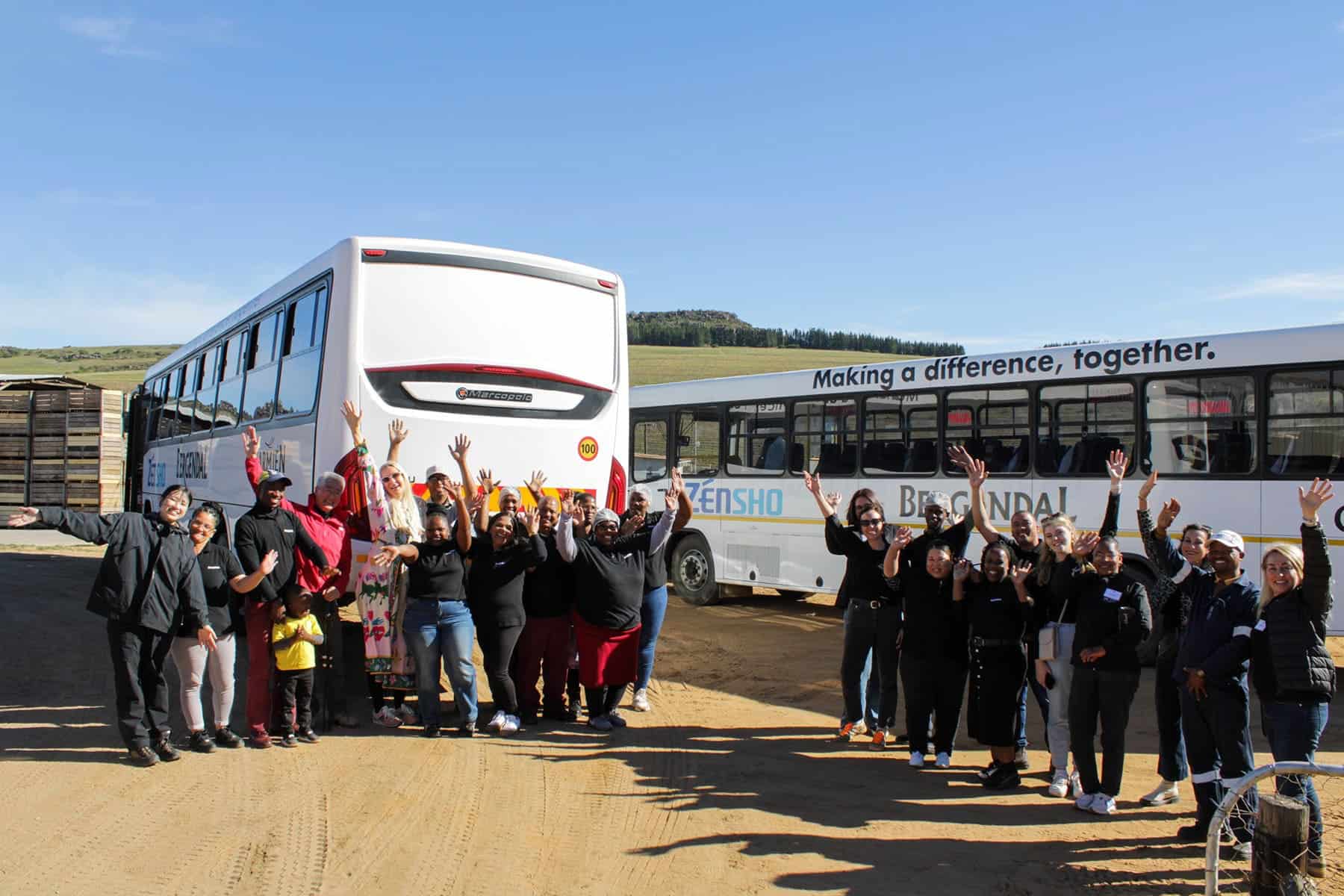
This week, one of Carmién Tea’s long-standing customers visited us in the Rooibos-growing community for a day of connection, conversation and first-hand experience. The visit included the unveiling of a bus generously donated for our workers – a practical investment that will improve mobility and access to essential services.
But the bus was only one part of our customer’s visit.
More importantly, we had the opportunity to spend time with people in the community, listen to their experiences and hear first-hand what some of these initiatives mean to them and their families. We took a drive in the newly donated bus, picking up workers along the way. As they joined us, they shared their stories – stories that brought the impact of these initiatives to life in a way that no report or statistic ever could.
Those conversations reminded us of something that can easily be lost when we talk about sustainability at a corporate level:
Impact is personal.
A statistic can tell you how many people benefited from a programme. A report can tell you how many children have access to education or how many people have received healthcare. But sitting on a bus, travelling through the community and hearing directly from the people whose lives have been touched by these initiatives is different.
It puts a human face to every number. Like that of Clemend, who started his journey at Bergendal as a general worker and has since been promoted to Stock Manager. He shared the following: “In 2012 we started a project where Bergendal paid for all of our driver’s licenses and I am proud to be one of the first to get my license. Now I have the privilege of driving you today with the bus, so you are in good hands! We also use the buses for youth events and for shopping trips on Saturdays”
Along the way, we heard stories of opportunity, education, family and progress.
Thobile, a Logistics Line Manager, spoke about the opportunity to work alongside his son, knowing that his son is well cared for, while also benefiting from access to education and the company’s food scheme.
“The impact that Bergendal has made for me…is to get the opportunity to work close to my son and also knowing that he is well looked after and getting free education and also that he is provided for with the food scheme at no cost.”
Emily Jephta, a Bergendal worker, shared how support from Bergendal helped her son pursue his studies at CPUT in Wellington, where he spent four years studying to become a teacher.
“I am glad to be a worker of Bergendal. I have a son who is 21 years old, who is a learner at CPUT in Wellington. He studied for four years for teaching. Bergendal helped me with a sponsorship for my son.”
These are not just ESG initiatives on a page.
They are people’s lives.
They are parents watching their children gain opportunities they may not otherwise have had.
They are workers building careers.
They are families gaining greater security.
And they are communities becoming stronger.
This is where the real value of ESG becomes visible.
Not in the language of a sustainability report, but in the stories people tell when you sit beside them and ask what the support has meant to them.
On paper, it is easy to describe what a bus does. It provides transport. It improves mobility. It makes it easier for people to get where they need to go. But spend time with the people who will actually use it, and the meaning becomes much bigger.
A bus can mean being able to get to work more reliably.
It can mean reaching a healthcare appointment.
It can mean getting children where they need to be.
It can mean fewer barriers between a person and an opportunity.
And that is when ESG stops being an acronym.
It becomes someone’s life.
ESG should change lives, not just reports
There is a growing expectation for businesses to demonstrate that their environmental, social and governance commitments are genuine. For companies sourcing agricultural products, this is particularly important. A supply chain is never simply a chain of transactions. It is made up of farms, workers, families, communities, suppliers and ecosystems. Responsible sourcing means considering what happens to those people and places alongside the product being produced.
At Carmién, our approach to social responsibility has developed from this understanding.
Our Rooibos is rooted in the Cederberg region of South Africa, and so is much of the story behind our business. Carmién has worked with farming communities and worker-owned structures for decades, with social investment extending into education, healthcare, childcare, skills development, housing and community infrastructure.
Through partnerships within our wider group and supply chain, these initiatives are designed to create opportunities and improve quality of life for the people connected to Rooibos production.
We call this Growing Goodness.
And while the phrase may sound simple, the idea behind it is not. It means recognising that a successful business has the ability – and perhaps responsibility – to create something positive beyond its own walls.
The difference between doing ESG and living it
There is a difference between doing ESG and living the values behind ESG.
The first can become a checklist. The second becomes part of how a business operates.
It is the decision to invest in early childhood development because giving children a stronger start can influence the opportunities available to them later in life. It is supporting healthcare because healthy communities are stronger communities. It is creating opportunities for workers and their families to participate in the economic value created by the products they help produce. It is investing in facilities and infrastructure because sometimes the things that make the biggest difference are surprisingly practical.
And it is listening.
Because the people who benefit from these initiatives are the ones who can tell us whether they are actually making a difference.
“This bus is very warm and comfortable and takes me to work every day. It keeps us safe.”
From a Rooibos field to a family, a community and a future
For an international tea buyer, responsible sourcing can sometimes feel far removed from the finished product.
A Rooibos shipment leaves South Africa. It arrives at a warehouse thousands of kilometres away. It becomes teabags, a private-label product, a wellness blend or a cup of tea on someone’s kitchen table. The distance can make it easy to forget where the story began.
But behind that product are people.
People who grow Rooibos.
People who process it.
People whose families and communities are connected to its production.
And people whose lives can be affected when businesses choose to invest responsibly in the places from which they source.
That is why we believe responsible sourcing is about more than knowing where your Rooibos comes from.
It is about understanding who is behind it…and whether they are better off because of the value that the supply chain creates.
For B2B buyers looking to understand the wider social impact behind Carmién Rooibos, our Social Impact programme and CSR Report provide more detail on the programmes, partnerships and measurable outcomes behind our work.
Sometimes the most powerful ESG story isn’t a number
The bus will become part of everyday life in the community.
Over time, it may become something ordinary. People will climb aboard. Journeys will be made. Appointments will be reached. Children will be transported. Workers will get to where they need to go. And perhaps that is the best measure of all.
Because the ultimate goal of ESG should not be to create impressive sustainability reports. It should be to create a world where those reports represent real improvements in people’s lives.
Where a commitment becomes an investment.
Where an investment becomes an opportunity.
Where an opportunity changes a person’s circumstances.
And where that change continues from one generation to the next.
This week, we were reminded of that.
We saw it in a bus. We heard it in the voices of the people we met. And we felt it in the stories they shared with us.
This is what Growing Goodness means to us.
Not simply doing good because it looks good on paper. But building a business where doing good can become part of someone’s everyday reality. Because the most meaningful ESG stories aren’t always found in the data. Sometimes, they’re found in the people.
Growing Goodness, together. 🌱
Sign up for the Newsletter
Enjoyed this insight? Subscribe to our B2B mailing list for market updates, product innovation, and supply intelligence—delivered straight from origin.
References
- Carmién Tea International (2026) 2025 CSR Report. Available at: https://carmientea.com/2025-csr-report/ (Accessed: 14 August 2026).
- Carmién Tea International (2026) Social Impact. Available at: https://carmientea.com/corporate-social-responsibility/ (Accessed: 14 August 2026).
- Global Reporting Initiative (2021) GRI 1: Foundation 2021. Available at: https://www.globalreporting.org/publications/documents/english/gri-1-foundation-2021/ (Accessed: 14 August 2026).