

Carmién » News »
Your Rooibos. Your Market. Your Way.
Your Rooibos. Your Market. Your Way.
17 September 2026
Excerpt:
Looking for a reliable Rooibos supplier? Explore bulk Rooibos, private label tea, branded Rooibos products, custom packaging, certifications and international supply solutions tailored to manufacturers, retailers and distributors across global markets.
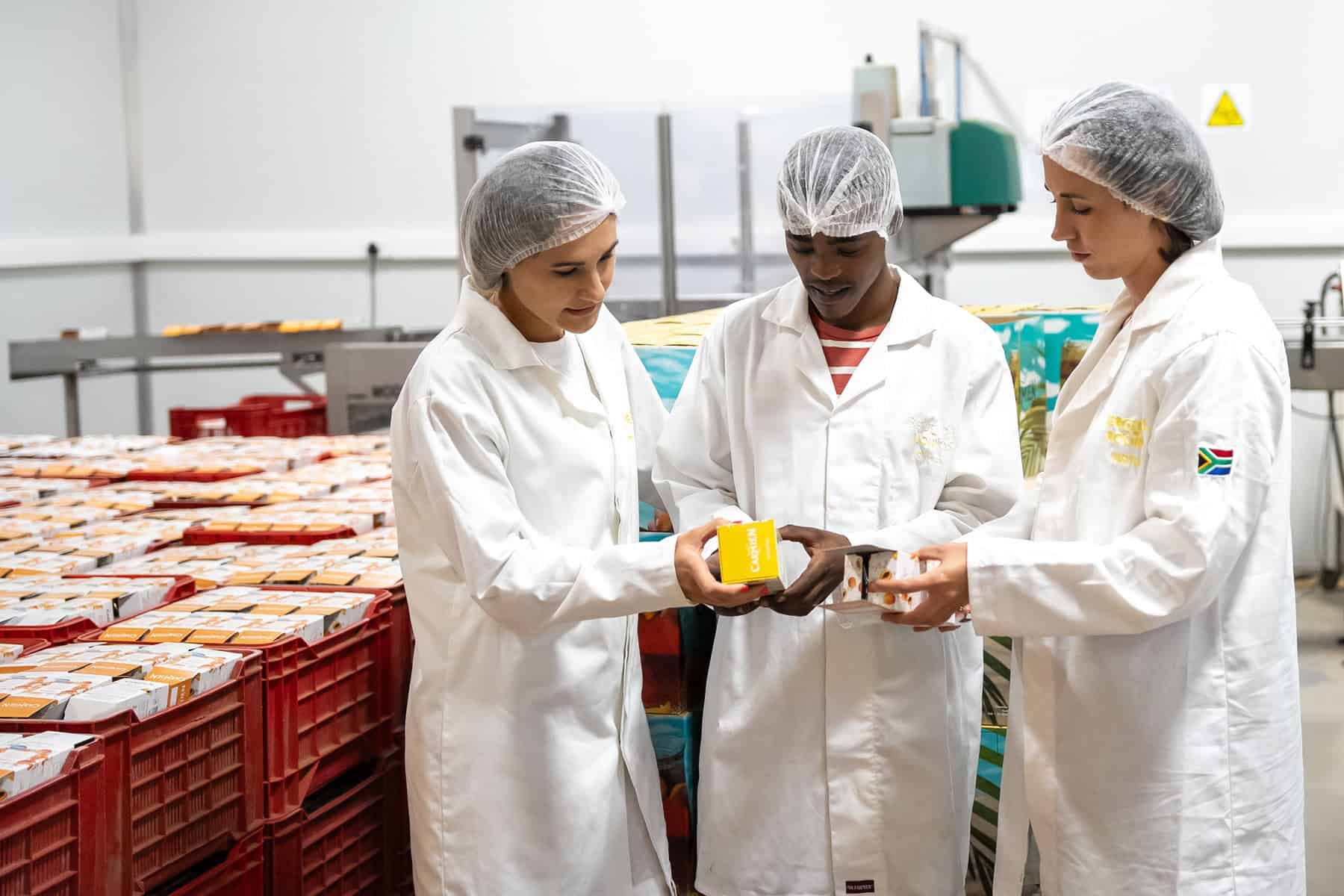
There is no such thing as a standard Rooibos customer.
A tea manufacturer may need a particular cut size for a specific application. A packing operation may require a precise bulk density for its machinery. A retailer may want a finished Carmién product that fits an existing category. Another customer may have identified a market opportunity and need a private-label product developed around it.
But before any of those requirements can be defined, there is a more fundamental question:
What are you trying to achieve?
Understanding the end product, the market it is intended for and the customer it needs to reach is the starting point for understanding what the Rooibos supply chain needs to deliver.
From there, the requirements become more specific: cut size, density, sensory profile, microbiological and residue results, certifications, packaging, documentation, volumes and delivery arrangements.
Good Rooibos supply is therefore about more than product availability. It starts with understanding what the customer is trying to achieve…and having the capability to build a supply solution around it.
Bulk Rooibos: the details matter
Bulk Rooibos can look simple on paper: a product, a volume and a delivery date.
In practice, the specification can be far more detailed.
Different applications may require different cut sizes. Packing machinery can perform differently depending on bulk density. Microbiological and residue requirements may be determined by the customer’s production process, market or own customer specifications. Certifications can also determine whether a particular raw material is suitable for its intended use.
Then there is the sensory profile. Colour, aroma, flavour and liquor characteristics can be just as important as an analytical specification.
That is why a good bulk conversation starts with the application, not simply the number of tonnes required.
The better the end use is understood, the more precisely the raw material can be matched to it.
Private label: making an idea come to life
Private label is about more than putting a customer’s name on an existing product.
Sometimes the customer knows exactly what they want. Sometimes they have identified a gap or opportunity in their market and need to turn an idea into a viable product.
That can involve the blend, flavour profile, tea bag format, pack size, artwork and the regulatory or market requirements behind the finished product. Format matters too. Pillow and pyramid tea bags, loose tea and different pouch configurations can create very different propositions for different markets.
The strongest private-label solutions bring these elements together.
The product needs to work for the consumer, the packaging needs to work for the product, and the finished format needs to work for the market.
Carmién branded: different products for different markets
The same principle applies when a customer chooses a branded product.
Different markets have different consumer expectations, so the same product is not necessarily the right answer everywhere.
One market may respond to pure Rooibos; another may have stronger potential for flavoured products. A retailer may be looking for a wellness proposition, a women’s range or a premium pyramid tea bag.
The opportunity is not simply to put the same product into as many markets as possible. It is to understand what makes sense for that particular market and customer – and select accordingly.
Different markets need different answers
Rooibos has an increasingly international footprint, but the requirements around it vary considerably.
Consumer preferences, retail environments, consumption habits, packaging expectations, certification requirements and regulatory frameworks are different from one market to another.
Its origin also matters. Rooibos is intrinsically connected to South Africa and the Cederberg, and that geographical identity is increasingly recognised as part of its value. In 2021, Rooibos became the first African product to receive Protected Designation of Origin (PDO) status in the European Union, providing legal protection for the name within the EU (Government of South Africa, 2021; European Commission, 2026).
For an international buyer, sourcing Rooibos is therefore not simply about finding a product that meets a specification. It is about finding a supply solution that fits the market the product is ultimately entering.
Understanding a customer’s needs — even as they evolve
The part of the supply chain that consumers never see can have a significant impact on whether a supply solution works.
Once the product is agreed, there is still a journey between production and the customer’s door: production planning, packing, documentation, freight, customs, stockholding and delivery. The right model might be a direct bulk shipment, a finished-product programme, stock held closer to the market or forecast-based supply.
And that model can change.
A customer may start with smaller volumes and move into regular container shipments. A successful product may lead to new pack formats or additional markets. As volumes grow, a supply model that once made sense may no longer be the most efficient.
This is where a real, transparent customer relationship matters.
A specification tells a supplier what the customer is buying. A relationship helps both sides understand why.
How is the product being used? What does the customer’s production process require? What does their market expect? What are their own customers asking for? Where is the business going, and what might it need from its supplier as it grows?
Those questions do not always have answers at the first quotation. They develop over the life of the relationship, as both sides gain a better understanding of the business and where it is heading.
Trust is built through that ongoing exchange. It means being clear about what is possible, identifying constraints early, and then working together to find solutions within those parameters. Sometimes the best answer is not immediately obvious, but understanding the customer’s objective can open up another way of achieving it.
That is what turns a supplier relationship into a partnership: not simply fulfilling an order, but working together to find the right solution as the customer’s needs evolve.
This is where integration matters
Flexibility is only useful when it is backed by capability.
An integrated Rooibos supply chain brings together sourcing, processing, blending, product development, packing and international supply, all while understanding the technical requirements at each stage.
That matters whether the requirement is a tightly specified bulk Rooibos, a particular sensory or analytical profile, a finished branded product or a private-label concept requiring product development and a specific packing format.
At Carmién, these capabilities are connected within one supply chain, from Rooibos sourcing and processing at Bergendal through to product development, packing and international supply.
Because ultimately, the question is not simply what Rooibos can be supplied.
It is what the customer is trying to achieve — and what needs to happen between the Cederberg and their market to make it possible.
Rooibos starts in the Cederberg. What happens from there should be shaped around where you want to take it.
Sign up for the Newsletter
Enjoyed this insight? Subscribe to our B2B mailing list for market updates, product innovation, and supply intelligence—delivered straight from origin.
References:
- European Commission (2026) Trade relations with Southern African Development Community (SADC). European Commission. Available at: https://policy.trade.ec.europa.eu/eu-trade-relationships-country-and-region/countries-and-regions/southern-african-development-community-sadc_en
- Government of South Africa (2021) Premier Alan Winde on Western Cape Rooibos industry’s contribution to local economy. Department of the Premier, Western Cape. Available at: https://www.gov.za/news/mec-ivan-meyer-welcomes-european-commission-designation-rooibos-red-bush-protected-product
- South African Department of Agriculture (2026) Export certification procedures. Department of Agriculture. Available at: https://www.nda.gov.za/index.php/publication/539-export-certification-procedures
- South African Rooibos Council (2026) Frequently Asked Questions. South African Rooibos Council. Available at: https://sarooibos.co.za/frequently-asked-questions/