

Carmién » News »
Understanding Incoterms®: Who Pays, Who Risks, Who Delivers?
Understanding Incoterms®: Who Pays, Who Risks, Who Delivers?
11 August 2026
Excerpt:
Incoterms® can significantly affect the real cost, risk and responsibility behind an international order. Understand EXW, FOB, CFR, CIF and DAP to compare supplier quotations and landed costs.
EXW. FOB. CFR. CIF. DAP.
Three letters can have a surprisingly significant impact on the real cost, risk and responsibility behind an international order.
For procurement teams sourcing tea, botanicals and other food ingredients internationally, choosing an Incoterm® is not simply a question of deciding who pays for freight. It can determine where delivery takes place, when risk transfers, which party arranges transportation, and who is responsible for export and import formalities.
That can make a major difference when comparing supplier quotations.
A lower FOB price and a higher DAP price, for example, are not necessarily more or less competitive without understanding what is included in each quotation.
What are Incoterms®?
Incoterms® are a set of 11 standardised international trade rules developed by the International Chamber of Commerce (ICC). The current edition is Incoterms® 2020, which establishes standardised responsibilities between buyers and sellers relating to delivery, risk, costs, transport, insurance and customs obligations (ICC, 2020; DHL Global Forwarding, n.d.).
Incoterms® provide a common language for international trade. They help establish who arranges and pays for transportation, who carries risk during different stages of the journey, and who is responsible for customs and other obligations (DHL Global Forwarding, n.d.; Maersk, 2024).
The 11 rules are divided into two broad groups. Four Incoterms®, FAS, FOB, CFR and CIF, are specifically intended for sea and inland waterway transport. The remaining seven can be used for other modes of transport, including road, rail, air or multimodal transportation (DHL Global Forwarding, n.d.; Maersk, 2024). In this guide, however, we focus on EXW, FOB, CFR, CIF and DAP – five Incoterms® that can be particularly relevant to the international procurement and supply scenarios faced by buyers sourcing tea, Rooibos, Honeybush and other botanical products.
For procurement teams, the simplest way to understand an Incoterm® is to ask four questions:
- Who pays? Which party pays for transport and other costs?
- Who carries the risk? At what point does responsibility for loss or damage move from seller to buyer?
- Who handles what? Who arranges export, import, customs and delivery?
- Where does delivery occur? At the supplier’s premises, at the port, on board the vessel or at the buyer’s destination?
There is, however, one important distinction: Incoterms® do not determine when ownership or title to the goods transfers. They establish delivery, cost and risk responsibilities, while ownership or title needs to be addressed separately in the sales contract (ICC, 2020; DHL Global Forwarding, n.d.).
Understanding that distinction is vital because the point at which risk transfers and the point at which ownership transfers are not necessarily the same.
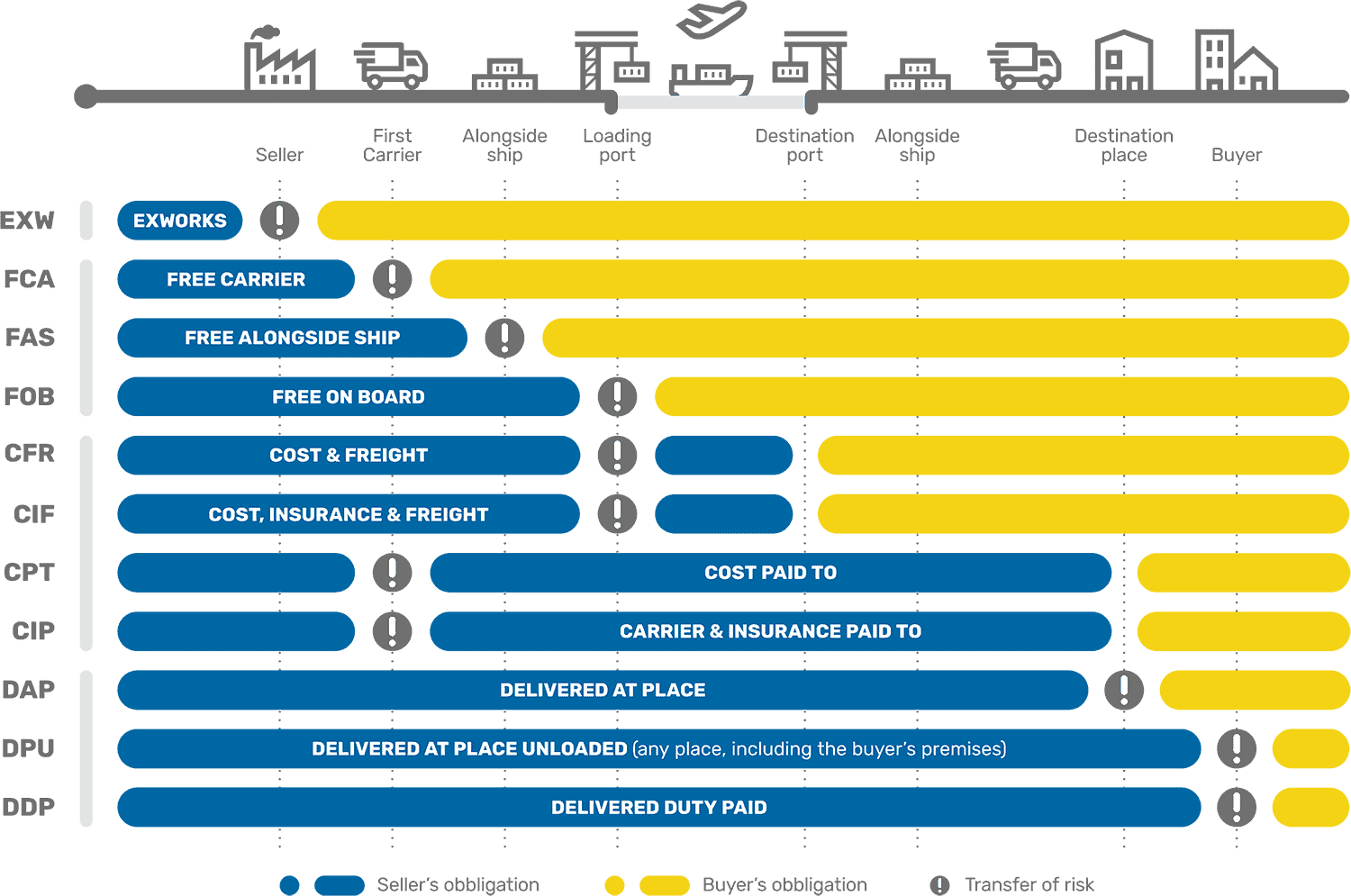
Figure 1: Incoterms 2020 Chart. Image courtesy of Cargo Compass.
EXW: Ex Works
Under EXW, the seller makes the goods available at an agreed location, typically the seller’s factory or warehouse.
The buyer takes responsibility from that point, including arranging transportation and managing the subsequent costs and risks. This places almost all delivery obligations with the buyer from the initial point of shipment (DHL Global Forwarding, n.d.). For an international buyer, this can appear attractive because the supplier’s quoted product price may be relatively low. However, the buyer is taking on considerably more responsibility. Export formalities may be difficult for foreign buyers to handle in some jurisdictions, which is one reason FOB is often preferred in international trade.
The buyer is effectively arranging the logistics from the seller’s premises onwards. That means costs beyond the product price need to be considered carefully, including transportation, export-related requirements, international freight, insurance, import clearance and onward delivery where applicable. This is where an EXW quotation can become misleading if it is compared directly with a quotation that includes freight and delivery.
Procurement takeaway: Don’t compare an EXW quotation directly with a freight-inclusive quotation without calculating the complete landed cost. Make sure you are fully equipped to manage transportation, export-related requirements, international freight, insurance, import clearance and onward delivery before choosing EXW.
FOB: Free On Board
Under FOB, the seller delivers the goods on board the vessel nominated by the buyer at the named port of shipment.
Under these terms, risk transfers to the buyer once the goods are on board the vessel (ICC, 2020; DHL Global Forwarding, n.d.). The seller handles export clearance, while the buyer generally takes responsibility for the main international freight, insurance and import formalities. For buyers who manage their own international freight arrangements, FOB can provide greater control over the shipping process. The buyer takes responsibility for the ocean freight, insurance and destination-side costs, while the seller covers export-related and vessel-loading costs (Maersk, 2024).
The important point is that the seller’s responsibility does not continue throughout the ocean journey. Once the goods have been delivered on board the vessel, the risk moves to the buyer, even though the goods may still be far from their destination.
Procurement takeaway: A competitive FOB price can be attractive, but don’t assume arranging freight yourself will be cheaper. Suppliers shipping higher volumes may secure better freight rates. Compare the full landed cost before deciding.
CFR: Cost and Freight
CFR goes one step further than FOB in terms of the seller’s freight obligation.
The seller arranges and pays the freight to the named destination port. However, risk transfers to the buyer when the goods are loaded on board the vessel at the port of shipment, not when they arrive at the destination (ICC, 2020; DHL Global Forwarding, n.d.). This distinction is particularly important.
A buyer may see a CFR quotation and assume that the supplier remains responsible for the goods until they reach the destination port. Under CFR, that is not the case. Under CFR, the seller pays the main ocean freight, but the buyer carries the transit risk after the goods have been loaded on board and remains responsible for insurance and many destination-side costs (Maersk, 2024). CFR also does not require the seller to arrange cargo insurance. Buyers should therefore consider whether their own insurance arrangements provide adequate cover (DHL Global Forwarding, n.d.).
For procurement teams, this means that a CFR quotation can look attractive because the international freight is included, while the buyer still needs to account for insurance and the risk associated with the journey.
Procurement takeaway: CFR can simplify freight procurement while leaving transit risk with the buyer. If you already have cargo insurance in place, compare the CFR price and your existing insurance arrangements against other quotation options.
CIF: Cost, Insurance and Freight
CIF is similar to CFR, but the seller also arranges cargo insurance to the named destination port.
Importantly, the addition of insurance does not mean that risk remains with the seller until arrival. Risk still transfers when the goods are delivered on board the vessel at the port of shipment (ICC, 2020; DHL, 2025). The seller therefore pays for the main freight and arranges the required cargo insurance, but the buyer assumes the risk once the goods are on board. Under Incoterms® 2020, the standard insurance obligation under CIF is based on minimum cover. Buyers requiring broader protection should examine the insurance terms rather than assuming that CIF provides comprehensive coverage (DHL Global Forwarding, 2020). Buyers should understand what the supplier’s insurance covers, the level of cover provided and whether additional protection is required.
CIF therefore differs from CFR primarily in the seller’s obligation to arrange insurance. The underlying transfer of risk remains at the same point – when the goods are on board the vessel (DHL, 2025).
Procurement takeaway: CIF can make quotation comparison easier by including freight and insurance, but buyers should still examine the insurance coverage and understand when risk transfers.
DAP: Delivered at Place
At the opposite end of the spectrum is DAP.
Under DAP, the seller arranges and bears the costs and risks of transporting the goods to the named destination. Delivery, and therefore transfer of risk, occurs when the goods arrive at the agreed destination ready for unloading (ICC, 2020; DHL Global Forwarding, n.d.). The buyer remains responsible for import clearance, duties and taxes, as well as unloading unless otherwise provided for under the contract of carriage.
For procurement teams, DAP can appear attractive because more of the logistics chain is incorporated into the supplier’s quotation. However, that does not necessarily make it the most cost-effective option.
A buyer based at the destination may be able to arrange on-carriage through local freight and transport providers at more competitive rates than a supplier arranging the same service from overseas. The supplier also builds additional logistics coordination, risk and margin into the DAP price. DAP can therefore be a more expensive option, particularly where the buyer can arrange destination logistics directly rather than through third parties.
Procurement takeaway: DAP may offer convenience, but don’t assume it offers the best price. If you can arrange destination logistics directly, compare the supplier’s DAP price against CFR or CIF plus your own destination handling and on-carriage costs.
Don’t compare the three letters, compare the complete cost
When evaluating international tea suppliers, the Incoterm® should be treated as part of the commercial offer, not as an afterthought.
A procurement comparison should consider:
Product price + freight + insurance + port costs + customs + duties/taxes + inland delivery + other applicable charges = landed cost.
It should also consider risk exposure.
Two suppliers could offer the same Rooibos specification at apparently different prices under different Incoterms®. The price difference does not necessarily represent a difference in product value. It may simply reflect a different allocation of logistics costs and responsibilities. A procurement team should compare quotations on a like-for-like basis, considering both the total cost and the risk and responsibility attached to that cost.
Incoterms® affect not only freight responsibility, but also insurance, customs formalities and destination-side costs. These factors should therefore form part of the procurement comparison rather than being considered separately after the supplier has been selected (DHL Global Forwarding, n.d.; Maersk, 2024).
What buyers should provide when requesting a quote
To enable the supplier to quote accurately and ensure both buyer and seller are completely aligned on the terms of the transaction, the buyer should provide:
- Product specification: exact product, grade, cut, packaging format and quantity.
- Order quantity and load details: total volume, number of pallets/cartons/bags and, where relevant, expected annual volume. Include pallet type, dimensions, height and weight restrictions where applicable.
- Delivery destination: the named destination port or, if requesting DAP, exact delivery address.
- Preferred Incoterm®: e.g. EXW, FOB, CFR, CIF or DAP, including Incoterms® 2020.
- Shipping requirements: FCL/LCL requirements or any specific routing requirements.
- Import requirements: destination country and any relevant customs, documentation, labelling or regulatory requirements the supplier needs to consider.
- Insurance expectations : whether the buyer requires the supplier to include insurance and, where relevant, any specific coverage requirements.
- Delivery requirements: requested delivery window, required arrival date and any special delivery conditions.
Providing this information upfront helps the supplier understand exactly what is being requested and gives the buyer a much stronger basis for comparing quotations.
In other words, The buyer shouldn’t simply ask: “What is your price?”
They should ask: “What is your price for this product, in this quantity, packed this way, delivered to this destination, under this Incoterm® and within this timeframe?”
That gives the supplier the information needed to build a properly comparable quotation.
The bottom line for international procurement
Incoterms® are ultimately about clarity.
For buyers sourcing Rooibos, Honeybush, botanicals or finished tea products internationally, understanding the difference between EXW, FOB, CFR, CIF and DAP can prevent unexpected freight costs, misunderstandings about risk and gaps in insurance or customs responsibility.
The most attractive quotation is not necessarily the one with the lowest product price.
It is the one where you understand exactly what you are paying for, exactly where your responsibility begins, and exactly what your final landed cost will be.
At Carmién, we work with international B2B customers to structure supply and logistics arrangements around their specific requirements. Whether a customer prefers to manage freight directly or requires a more delivered solution, clarity around costs, responsibilities and risk is an essential part of building a reliable international supply partnership.
Because when you are comparing suppliers, three letters can change much more than the price on the quotation.
References
- DHL Global Forwarding (n.d.) Incoterms® Explained. DHL. Available at: https://www.dhl.com/za-en/home/global-forwarding/freight-forwarding-education-center/incoterms-explained.html (Accessed: 7 August 2026).
- DHL Global Forwarding (2020) Incoterms® 2020 – Basic Overview. DHL. Available at: DHL Global Forwarding Incoterms® 2020 brochure (Accessed: 7 August 2026).
- DHL (2025) Incoterms® Explained for Small Businesses. DHL Express. Available at: DHL Incoterms® Explained for Small Businesses (Accessed: 7 August 2026).
- International Chamber of Commerce (ICC) (2020) Introduction to Incoterms® 2020. Paris: International Chamber of Commerce. Available at: ICC Introduction to Incoterms® 2020 (Accessed: 7 August 2026).
- Maersk (2024) Choosing the Right Incoterms® for Spot Shipping. A.P. Moller – Maersk. Available at: https://www.maersk.com/insights/digitalisation/2024/10/09/incoterms-spot-shipping (Accessed: 7 August 2026).
- CARGO COMPASS, 2020. Incoterms 2020 Chart [online image]. Available from: cargocompassworld.com (Accessed 7 August 2026).