

Health Benefits of Green Rooibos

Naturally
Caffeine-Free

Rich in
Antioxidants

Improves
Heart Health

Regulates
Blood-Sugar

Supports
Skin Health

Metabolic
Support
The primary nutritional benefit of green rooibos lies in its rich antioxidant content, potent enough to measurably elevate antioxidant levels in the blood, thereby boosting the body’s internal defence systems against disease.
The Difference Between Rooibos and Green Rooibos
Just as with black (Camelia Sinensis) and green tea, the difference lies in the processing. Rooibos goes through a fermentation (oxidation) process, which turns the green leaves into a reddish-brown colour and develops its distinctive aroma, while with Green Rooibos, the fermentation process is skipped, and the “green” leaves and stems are dried directly.
To ensure the natural oxidation process is stopped completely, the leaves are dried by hot air in a closed unit as soon as possible after cutting. This preserves high-quality green rooibos with optimum phenolic and low moisture content and excellent control of microbial activities to prevent any discolouring of the green leaves, giving it a longer storage time.
Green Rooibos Uses

Beverages

Culinary

Wellness

Cosmetics

Pet Care
Green Rooibos Tasting Notes
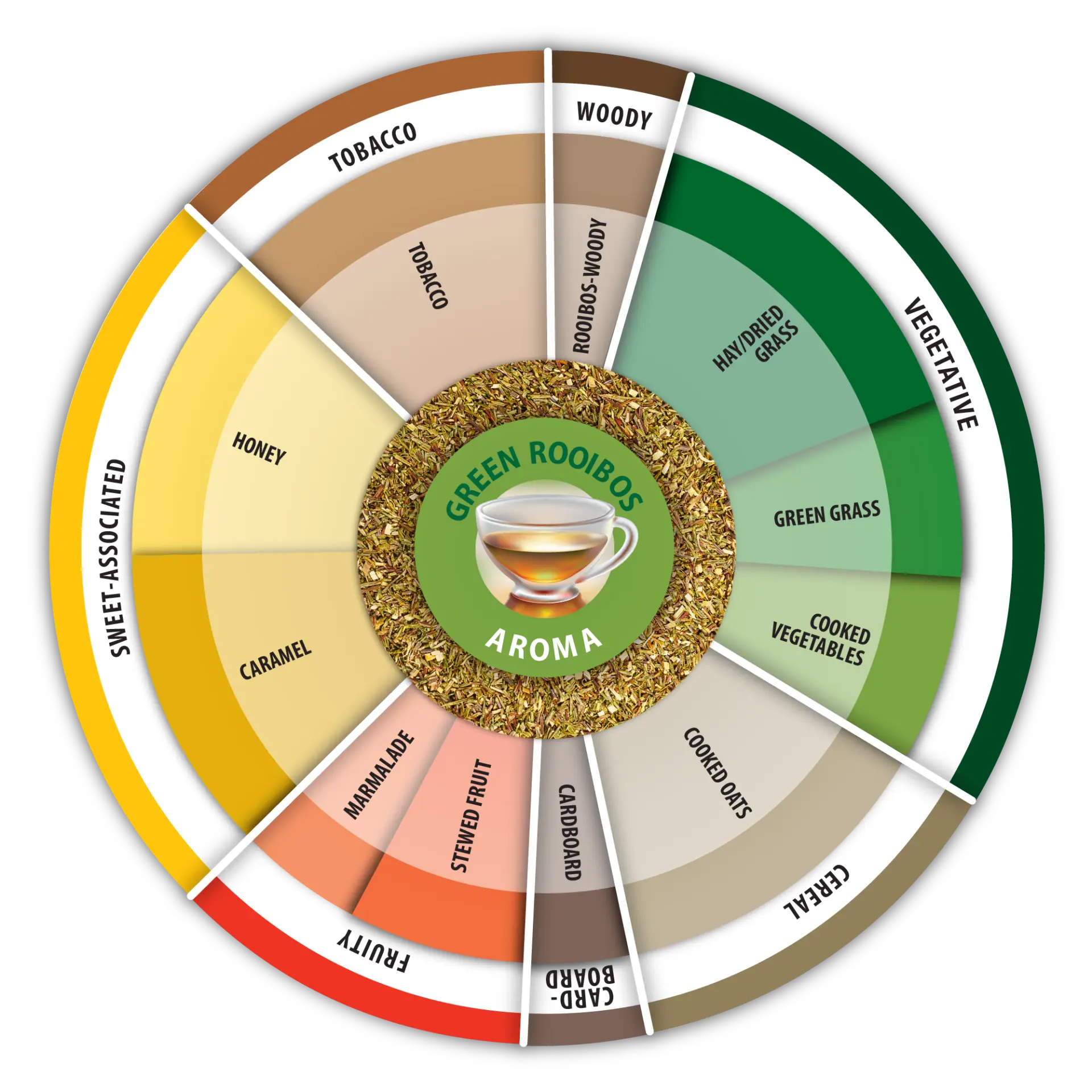
Green Rooibos tea has a slightly sweet, mild green (grassy) taste, with caramel notes and a smooth, enjoyable mouthfeel and flavour profile. Unlike Camellia Sinensis Green teas, Green Rooibos tea is low in astringency and has a distinctive light orange/tan to yellow cup infusion. Fermented (red) rooibos has a delicate balance of sweetness on the nose, slight astringency, and full, smooth mouthfeel with a fruity caramel taste, amber cup infusion, and typical sweet aroma.
Green Rooibos Aroma Wheel
Green Rooibos Production
Growing

Rooibos seeds are sown in nursery seed beds from February to March. After a few months, seedlings move to fields where they grow for about 18 months before they are ready to be harvested for tea production.
Harvesting

Rooibos is harvested once a year in summer and early autumn, from January to April. Branches are cut 50 cm above ground, bundled into sheaves, and taken to the drying yard for the next stage of tea production.
Drying

After cutting, Green Rooibos is immediately dried in a fluid bed dryer to prevent oxidation and preserve the material in its natural green state. It is then packed in bulk bags, labelled, and stored before further processing.
Sifting
and Storage

Rooibos passes through a series of sieves to remove stems, contaminants, and sharp cuts, ensuring a clean, uniform product. Once sorted by cut size and grade, the rooibos is stored in bulk bags under ideal conditions.
Pasteurisation

Rooibos is exposed to 160°C steam for 90 seconds to pasteurise it. After this, the tea is dried using hot air until the moisture content drops below 10%, ensuring a safe, shelf-stable, and quality product for export.
Magnetic
Metal Removal

Throughout processing, rooibos passes over several high-strength magnets to remove metal particles. This ensures the raw material is free from ferrous contaminants that may be left after the harvesting process.
Lab Analysis

Analytical tests are conducted at our in-house laboratory and at ISO 17025:2017-accredited external labs. Each finished batch undergoes pesticide residue screening and microbial analysis to ensure top quality and safety.
Export Analysis

PPECB collects a finished batch sample and conducts an independent analysis. After the batch passes all checks, a Certificate of Analysis is issued, combining all results, and PPECB provides an Export Licence for export.
Grades and Cuts
We offer Rooibos, Green Rooibos, and Honeybush in a variety of grades and cuts that are suitable for different applications, from traditional tea bags to cosmetics and wellness products. Find out about the various cuts on offer and their uses.
