
The Red Tea with Green Solutions: Exploring Carmién’s Plant-Based Teabag Innovation
07 April 2026
Excerpt:
Carmién combines rooibos expertise with plant-based, compostable teabag materials to meet evolving global demands. From premium pyramid to scalable pillow formats, its solutions deliver performance, compliance, and sustainability for modern tea markets.
The Evolving Role of Teabag Materials
As global tea markets become more sophisticated, teabag materials are no longer a purely functional consideration. For B2B buyers, they directly influence product quality, regulatory compliance, and sustainability positioning. Increasingly, retailers and regulators are scrutinising packaging for its environmental impact, particularly in markets such as the EU and UK where sustainable packaging requirements are tightening (European Commission, 2022).
Carmién’s approach reflects this shift, combining high-performance teabag design with plant-based, compostable materials to meet the expectations of modern retail and foodservice markets.
Pyramid Teabags: Premium Performance for Modern Tea Applications
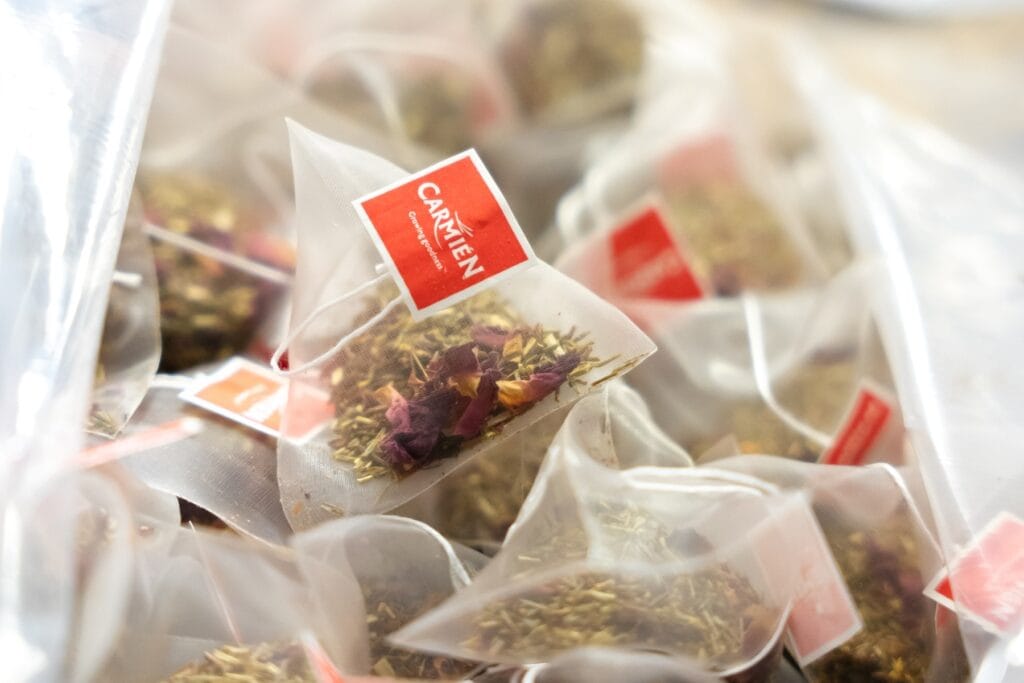
Carmién’s pyramid teabags are designed for premium tea applications, including blends with strong visual appeal and cold brew formats. Made from PLA (polylactic acid) derived from renewable plant sources such as cornstarch and sugarcane, these teabags provide a bio-based alternative to conventional plastics (European Bioplastics, 2023). Carmién offers both tagless bioweb pyramid teabags, made from a non-woven, fine-filament PLA, as well as tagged pyramid teabags, made from a fine woven PLA mesh.
The material is certified according to the EN13432 standard, ensuring it is industrially compostable under controlled conditions. This certification is widely recognised across European markets as a benchmark for compostable packaging compliance (CEN, 2000).
From a functional perspective, the pyramid structure allows for greater leaf expansion and improved water circulation. This enhances extraction efficiency, particularly in cold brew applications where longer infusion times require optimal contact between water and tea leaves. The result is a more robust flavour profile without increasing dosage, supporting premium product positioning and improved consumer experience.
Pillow Teabags: Scalable, Cost-Efficient Tea Packaging
Carmién’s pillow teabags are engineered for efficiency in high-volume production environments. The material consists of a blend of PLA fibres, abaca, and cellulose, combining plant-based inputs with the strength required for consistent performance.
Abaca, a natural fibre derived from the banana plant, is widely used in tea packaging due to its high wet strength and durability. This ensures the teabag maintains integrity during infusion while allowing effective water permeability.
Like the pyramid format, pillow teabags are also EN13432 certified, confirming their suitability for industrial composting. This makes them an ideal solution for private label tea, bulk rooibos supply, and foodservice channels, where cost efficiency and scalability are critical.
Plant-Based, Microplastic-Free, and Responsibly Designed Teabags
Across all formats, Carmién maintains a consistent material philosophy centred on plant-based, microplastic-free, and industrially compostable teabags. This is increasingly important as concerns around microplastics in food packaging continue to grow globally (European Commission, 2022).
The use of renewable materials such as PLA, abaca, and cellulose ensures that Carmién’s teabags do not rely on conventional petroleum-based plastics. According to European Bioplastics (2023), PLA is one of the most widely adopted bio-based polymers, offering a balance between performance and reduced environmental impact.
All Carmién teabag materials are certified to EN13432, meaning they are designed to biodegrade in controlled industrial composting environments. Under these conditions—where temperature, humidity, and microbial activity are optimised—the materials break down within a defined timeframe and do not leave harmful residues (CEN, 2000). However, these conditions are typically not present in home compost systems, making it important for brands to communicate compostability claims clearly and accurately to consumers.
Carmién’s design approach further enhances product safety and sustainability by eliminating glue, staples, strings*, and tags*. This reduces contamination risks and simplifies the material structure, while improving compatibility with high-speed packing processes.
In addition, all inks and glues used in packaging are food-grade and non-toxic, ensuring compliance with international food contact regulations such as those outlined by the FDA and global food safety bodies (FDA, 2020; FAO, 2018). This supports safe, scalable distribution across international markets.
Strategic Teabag Selection for B2B Buyers
For B2B buyers, selecting the right teabag format is a strategic decision linked to product positioning and target market requirements.
Pyramid teabags support premium tea offerings, enhanced infusion performance, and differentiated consumer experiences. In contrast, pillow teabags offer cost efficiency, consistency, and scalability, making them ideal for mainstream retail, private label, and bulk supply.
Both formats align with key global trends, including clean-label products, sustainable packaging, and reduced plastic exposure. As sustainability becomes a central procurement criterion, these factors are increasingly influencing retailer and buyer decisions (Smithers, 2022).
A Future-Focused Approach to Tea Packaging
Teabag materials may represent a small component of the final product, but their impact on brand perception, compliance, and environmental footprint is significant. Carmién’s investment in compostable teabag materials and plant-based packaging reflects a broader commitment to responsible sourcing and long-term sustainability.
By combining rooibos origin expertise with advanced packaging solutions, Carmién enables its B2B partners to meet evolving regulatory requirements and consumer expectations—while maintaining product quality and operational efficiency in global tea markets.
As a South African rooibos supplier operating within PDO-designated regions, Carmién ensures full traceability and export compliance. This origin-based advantage supports consistent quality, transparent sourcing, and alignment with international market standards.
For partners seeking to align product performance with sustainability and compliance, Carmién offers scalable solutions tailored to bulk or private label requirements.
*In tagless formats
References
- Carmién Tea (2026) Product and sustainability information. Available at: https://www.carmientea.com
- CEN (2000) EN 13432: Requirements for packaging recoverable through composting and biodegradation. Brussels: European Committee for Standardization.
- European Bioplastics (2023) Bioplastics market development update 2023. Available at: https://www.european-bioplastics.org
- European Commission (2022) Biodegradable and compostable plastics: framework and definitions. Available at: https://ec.europa.eu/environment/topics/plastics
- FAO (2018) Food safety and quality: materials in contact with food. Available at: https://www.fao.org
- FDA (2020) Food contact substances (FCS). Available at: https://www.fda.gov/food
- Smithers (2022) The future of sustainable packaging to 2027. Available at: https://www.smithers.com