
Rooibos Supply Outlook 2026: What Global Buyers Need to Know
25 March 2026
Excerpt:
The 2026 Rooibos season faces challenging climatic conditions. For international international bulk buyers , resellers, and private label partners, understanding supply dynamics is critical for
A Challenging Growing Season
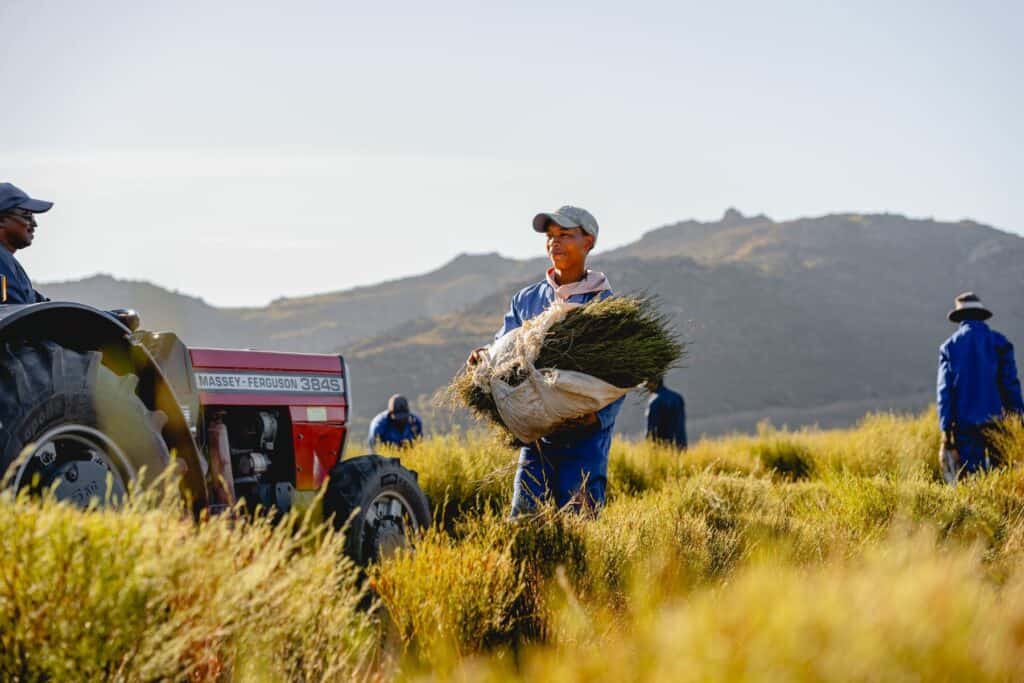
The Rooibos production region is a winter rainfall area, meaning crops rely heavily on rainfall during the cooler months, while summers are typically dry and extremely hot. During peak summer, temperatures often reach the mid-40 °C range. Normally, these dry conditions are moderated by intermittent thunderstorms, which provide essential moisture to support vegetative growth and plant health. However, this season’s thunderstorms largely failed to materialise. Rainfall across the production region has been well below average, with some areas recording virtually no rainfall since September.
Impact on Rooibos Plants and Yields
Rooibos is a dryland crop and is reliant on the prevailing weather conditions. The combination of summer sunlight and periodic summer showers usually stimulates strong growth in the months leading up to harvest. Without this moisture, plants have come under considerable stress, and many bushes have shed leaves in response to the prolonged dry conditions. This reduces plant density and directly lowers expected yield per hectare.
As conditions became clearer, producers were required to revise their 2026 Rooibos crop forecasts downward, in some cases by as much as 40%, reflecting the impact of drought on overall yields and anticipated volumes.
Supply and Demand Imbalance
Current industry estimates place the 2026 Rooibos crop at approximately 13 000 tons, while global demand is estimated at 19 600 tons. This imbalance between supply and demand is expected to place strong upward pressure on Rooibos pricing, particularly as long-term climate forecasts indicate continued drought conditions. Any persistent shortfall in rainfall could further constrain supply in coming seasons, making early procurement planning even more critical for bulk buyers, resellers, and private label partners.
Industry Stock Position and Forward Cover
It is standard practice within the Rooibos industry to maintain roughly one year’s reserve inventory as forward cover to mitigate supply risks associated with variable weather. Opening stock for 2026 is estimated at approximately 25 000 tons, although not all of this inventory is immediately marketable due format constraints. When combined with the projected 2026 crop of approximately 13 000 tons, total available volume for the year is estimated at around 38 000 tons. Given expected annual demand of 19 600 tons, the industry is projected to close 2026 with roughly 18 400 tons in reserve. This effectively means the industry will only just maintain one year of Rooibos stock cover, leaving limited buffer should adverse climatic conditions persist.
Carmién’s Advantage and the Path Forward
In a tightening supply environment, the ability to secure reliable, high-quality Rooibos at scale is a key differentiator. Carmién’s vertically integrated supply chain provides direct control from crop to cup. This enables supply security through direct sourcing relationships and controlled production, consistent quality across harvests even under variable climatic conditions, full traceability aligned with global retail and regulatory requirements, and operational flexibility to respond to shifting demand and market dynamics.
Carmién has also implemented proactive agronomic interventions to mitigate current weather impacts. In new plantings, supplementary watering has been applied to ensure strong seedling establishment, protecting future crop potential despite reduced rainfall. At a time when industry-wide reserve cover is only just maintained, this level of control and forward planning provides a clear strategic advantage and reinforces the importance of early engagement, transparent forecasting, and collaborative volume planning between suppliers and buyers.
Partner with Carmién
Carmién Tea is positioned to support international partners with stable, scalable, and fully traceable Rooibos supply — from crop to cup. To discuss forward volume planning, private label opportunities, or procurement strategies for 2026 and beyond, engage with the Carmién team early to align on supply requirements and ensure continuity in a constrained Rooibos market.
All crop, supply, and demand figures are based on current industry estimates and may be subject to revision as the 2026 season progresses.
References
- South African Rooibos Council (2024–2026). Industry statistics, crop estimates and market data. Available at: https://sarooibos.co.za
- Agricultural Research Council (n.d.). Rooibos production guidelines and agronomic practices. Available at: https://www.arc.agric.za
- South African Weather Service (2025–2026). Seasonal climate and rainfall reports. Available at: https://www.weathersa.co.za
- Western Cape Government (2025–2026). Agricultural and drought monitoring reports. Available at: https://www.westerncape.gov.za
- Industry estimates (2026). Rooibos crop forecasts and yield projections based on producer feedback.
- Market data sources (2024–2026). Global herbal tea demand estimates (SARC and industry reports)