
From Seedling to Supply: What Building the Next Rooibos Crop Really Looks Like
03 June 2026
Excerpt:
Every future Rooibos harvest begins with a tiny seed. Follow the remarkable journey from seedling to supply and discover the expertise, patience and long-term investment required to build tomorrow's Rooibos crop.
When buyers evaluate Rooibos supply, discussions often focus on harvest volumes, market availability, inventory levels and pricing. Yet long before Rooibos reaches the field – and years before it reaches consumers around the world – an equally important process begins at origin.
Every future Rooibos harvest starts with something remarkably small: a seed.
For tea buyers, procurement teams, private label brands and manufacturers seeking reliable bulk Rooibos supply, understanding what happens between seed collection and commercial harvest provides important perspective on supply continuity and long-term sourcing security. Building the next Rooibos crop is not a short-term exercise. It is a multi-year investment requiring expertise, patience and careful agricultural planning (Department of Agriculture, Forestry and Fisheries, 2010; South African Rooibos Council, 2024).
As global demand for South African Rooibos tea continues to grow, the journey from seedling to supply has become increasingly important for buyers looking to build resilient sourcing strategies.
It Starts With Seed Collection
Every future Rooibos harvest begins with seed collection.
Rooibos (Aspalathus linearis) is a legume that produces tiny seed pods, each typically containing a single hard-shelled seed measuring only about 2 mm in diameter. As the pods mature, they split open naturally, releasing their seeds onto the sandy soil beneath the plants. These seeds are then painstakingly collected by carefully sifting the sand beneath established bushes. It is a labour-intensive process that requires considerable skill and patience under the harsh African sun.
The seeds themselves present another challenge. Rooibos produces hard-coated dicotyledonous seeds with naturally low germination rates – unless they undergo specialised scarification and pre-treatment processes to break dormancy and improve germination success. Even under controlled nursery conditions, successful establishment can be difficult, making seed quality and handling critical from the outset (Department of Agriculture, Forestry and Fisheries, 2010; SAQA, n.d.).
Given their tiny size, natural dormancy and the demanding collection process, not every seed collected ultimately becomes a healthy Rooibos plant. For producers, seed collection is therefore far more than a seasonal activity; it is the first investment in securing future Rooibos supply. For buyers, it serves as a reminder that reliable bulk Rooibos supply begins years before harvest, starting literally from the ground up. At Carmién, this close connection to origin provides valuable visibility into crop development and future supply planning.
The Nursery Stage: Building Strong Foundations
Following collection and treatment, Rooibos seeds are typically sown into specialised nurseries at the start of winter. In the Rooibos-growing regions of the Western and Northern Cape, winter brings the majority of annual rainfall, creating favourable conditions for early seedling development. Over the following months, the young plants are carefully nurtured in the nursery until they are ready for transplanting into production fields during spring.
The nursery phase is one of the most labour-intensive stages of the Rooibos production cycle. Seedlings require ongoing attention, including watering, weeding and thinning to ensure that only the strongest and healthiest plants continue to develop. Temperature, moisture and growing conditions must be carefully managed to encourage healthy germination, root development and plant vigour (South African Rooibos Council, 2024; Rooibos Ltd, 2025).
By the time spring arrives, the objective is not simply to have grown seedlings, but to have developed resilient young plants capable of surviving the challenging dryland farming conditions they will encounter in the field. For producers, this investment in seedling development forms a critical foundation for future crop performance and long-term Rooibos supply resilience.
Planting for a Future Harvest
In the Rooibos-growing regions of South Africa, the transplanting of Rooibos seedlings into the fields follows the winter rainfall season, when soil moisture levels and underground water reserves are typically at their highest. Establishing young plants under these conditions helps maximise survival rates and gives seedlings the best possible opportunity to develop strong root systems before the hot, dry summer months arrive.
Rooibos is cultivated exclusively within the designated Rooibos-growing regions of South Africa’s Western and Northern Cape provinces – the only region in the world where Rooibos occurs naturally and can be commercially produced. The combination of sandy, acidic soils, a Mediterranean climate and winter rainfall patterns creates a growing environment found nowhere else on earth (Department of Agriculture, Forestry and Fisheries, 2010; Rooibos Ltd, n.d.). This unique link between product and place was formally recognised in 2021 when Rooibos was granted Protected Designation of Origin (PDO) status by the European Union, ensuring that only Rooibos grown within these defined geographical areas may be marketed as Rooibos in the EU. This designation reflects the inseparable relationship between Rooibos quality, characteristics and its region of origin. (European Commission, 2021).
Even with careful planning, young Rooibos plants remain particularly vulnerable during establishment. Heat stress, prolonged dry conditions and below-average rainfall can reduce establishment success and affect future yields (Western Cape Department of Agriculture, 2020). Successful crop establishment therefore depends not only on the quality of the seedlings, but also on timing, environmental conditions and ongoing stewardship during these critical early months.
Recent seasons have highlighted the importance of resilience planning.
At Carmién, investments continue not only in current production but also in supporting the successful establishment of future Rooibos plantings, helping secure long-term supply continuity.
Harvesting the Investment
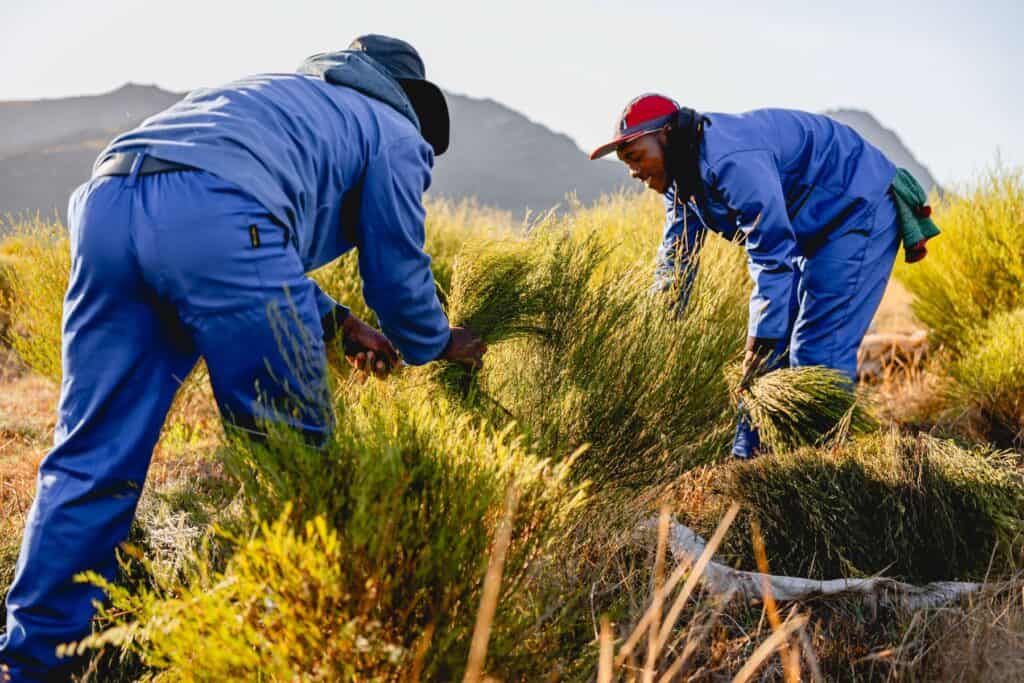
The journey does not end once Rooibos is established in the field. Approximately 18 months after planting, young Rooibos undergoes its first harvest, known as “topping.” During this stage, only a small portion of the upper growth is removed. Rather than maximising immediate yield, the objective is to encourage branching and bush formation, helping build a stronger, more productive plant for future harvests. Thereafter, the bushes enter their primary production years and are typically harvested annually for around three seasons. Harvesting takes place during the height of the hot, dry summer and remains a largely manual process. Using sickles or scythes, harvesters carefully cut the entire bush at approximately 50 cm above ground level before the Rooibos is bundled and transported for processing.
Following the final harvest, the remaining plant material is worked back into the soil and cover crops are planted. The land is then rested and regenerated for several years before Rooibos is replanted. This rotation cycle helps restore soil health, improve soil structure and support the long-term sustainability of Rooibos production. At Carmién, these practices form part of a broader commitment to responsible farming and preserving the long-term productivity of the land for future generations.
Why Long-Term Planning Matters
From seed collection and nursery development through to crop establishment, harvesting and soil regeneration, Rooibos production operates on a timeline measured in years rather than months. Building future production capacity requires continuous investment long before product reaches the marketplace.
For buyers, this highlights the importance of working with suppliers that remain closely connected to origin. At Carmién, our involvement across the value chain provides valuable visibility into crop development, new plantings and future production capacity, helping customers navigate changing market conditions with greater confidence. Simply put, reliable Rooibos supply is not created overnight. Supply continuity begins years before a crop is harvested (SAQA, n.d.; South African Rooibos Council, 2024).
Looking Beyond the Current Season
Discussions around Rooibos crop forecasts understandably focus on current production conditions, inventory levels and immediate supply outlooks, but behind every future Rooibos harvest lies years of preparation taking place quietly in the background…
From harvesting seeds to nurturing seedlings and establishing future plantings, building the next Rooibos crop represents a continuous investment in sustainability, continuity and long-term supply security. For tea brands, manufacturers, retailers and ingredient buyers, understanding this journey offers an important reminder: Reliable Rooibos supply starts long before Rooibos reaches the field.
At Carmién, our close connection to origin provides a unique perspective on this journey. By remaining engaged with the process from seedling development through to harvest and processing, we are able to support greater supply continuity, traceability and sourcing confidence for our customers. After all, the future of Rooibos supply is built long before the next harvest begins.
Let’s Build Your Rooibos Supply Strategy
Whether you are sourcing bulk Rooibos, developing a private label tea range, launching a new product or expanding an existing tea portfolio, understanding how future crops are built is an important part of building a resilient supply strategy.
At Carmién Tea, our integrated approach allows us to work closely across the value chain – from crop development and future plantings through to processing, quality assurance and global export supply. By remaining closely connected to origin, we help customers navigate changing market conditions while supporting long-term sourcing confidence, traceability and supply continuity.
References
- Department of Agriculture, Forestry and Fisheries (2010) Rooibos Tea Production Guideline. Pretoria: Department of Agriculture, Forestry and Fisheries.
- Rooibos Ltd (n.d.) About Rooibos. Available at: https://rooibosltd.co.za (Accessed: 29 May 2026).
- Rooibos Ltd (2025) Rooibos Seedling Development and Nursery Practices. Available at: https://rooibosltd.co.za (Accessed: 29 May 2026).
- South African Qualifications Authority (SAQA) (n.d.) National Certificate: Rooibos Tea Production. Available at: https://www.saqa.org.za (Accessed: 29 May 2026).
- South African Rooibos Council (2024) Rooibos Cultivation and Industry Information. Available at: https://sarooibos.co.za (Accessed: 29 May 2026).
- Western Cape Department of Agriculture (2020) Rooibos Production and Climate Resilience. Elsenburg: Western Cape Government.