
Antioxidants, Explained: What they do, and why rooibos being naturally rich in them matters
17 December 2025
Excerpt:
Antioxidants are your body’s natural “damage control” helpers. Learn what they do, how rooibos delivers them naturally, and why this caffeine-free tea is a
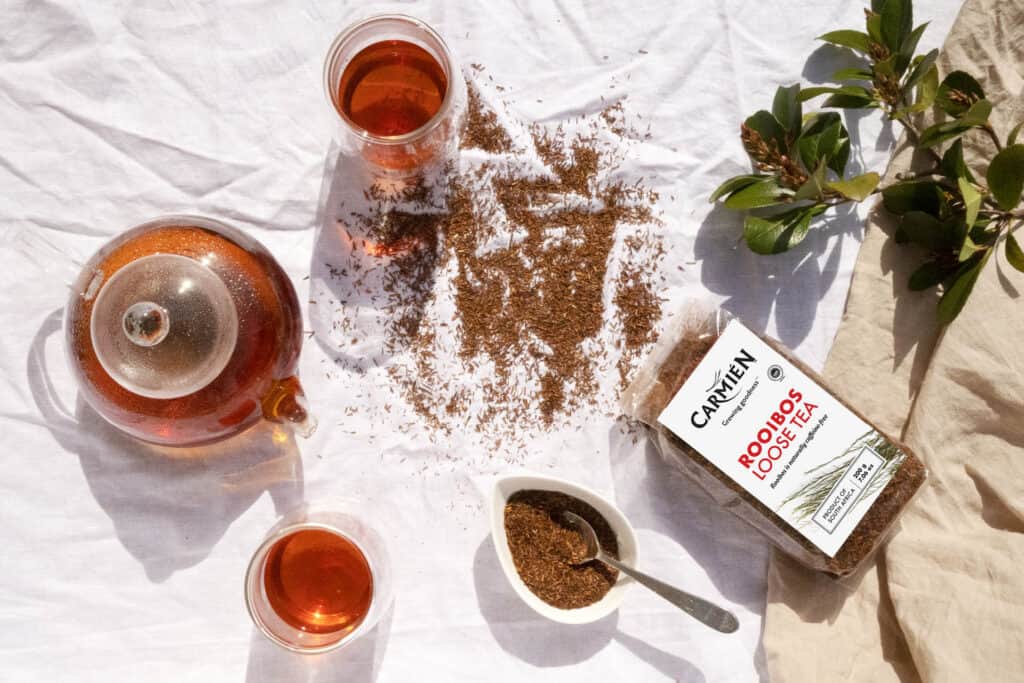
“Rich in antioxidants” is one of those phrases people recognise as positive, but it often lands as a vague health halo. To understand why rooibos has earned that reputation, it helps to start with what antioxidants actually are, what they do in the body, and what makes rooibos’ antioxidant profile so distinctive.
What are antioxidants?
Antioxidants are molecules that help protect cells from damage caused by free radicals, which are highly reactive, unstable molecules that can be created during normal metabolism (your body turning food into energy) and also through external exposures like UV light, air pollution, cigarette smoke and certain chemicals (NIGMS, 2023; Medical News Today, 2023).
When free radicals build up faster than the body can neutralise them, it can lead to oxidative stress — an imbalance that can damage DNA, proteins, and cell membranes, and is associated with ageing processes and a range of chronic disease pathways (Medical News Today, 2025; Pizzino et al., 2017; Chaudhary et al., 2023).
What antioxidants actually do (in plain English)
Free radicals are missing an electron, which makes them “grabby.” They can start chain reactions that disrupt normal cell structure and function. Antioxidants work as “chain-breakers”: they can donate an electron (or otherwise stabilise reactive molecules) so the free radical stops reacting and the chain reaction ends (NIGMS, 2023; Penn State University, n.d.; Better Health Channel, 2024).
Your body isn’t passive in this process. It has its own built-in antioxidant defence systems (enzymes and compounds such as glutathione) — but it also relies heavily on dietary antioxidants, including vitamins (like C and E), carotenoids and plant polyphenols (Medical News Today, 2023; Healthline, 2023).
Why “food antioxidants” matter more than “antioxidant supplements”
A key nuance: evidence consistently supports antioxidant-rich diets (think colourful plant foods and antioxidant-containing beverages like tea), but high-dose antioxidant supplements don’t reliably replicate those benefits — and in some contexts may even be harmful (Medical News Today, 2021; Mayo Clinic, n.d.). The working view in mainstream health guidance is that antioxidants are best approached as part of an overall eating pattern, not as isolated megadoses in capsule form (Medical News Today, 2021; Better Health Channel, 2024).
That’s where rooibos fits neatly: it’s a simple, everyday format for plant polyphenols — without needing to turn antioxidants into a “project.”
Rooibos and antioxidants: what makes it different?
Rooibos (Aspalathus linearis) is naturally caffeine-free and contains a distinctive set of polyphenols. Two compounds often highlighted are aspalathin and nothofagin, which are closely associated with rooibos’ antioxidant profile (Villaño et al., 2010; Snijman et al., 2009). Rooibos also contains other flavonoids such as quercetin, luteolin, and rutin (Nordqvist Tea, 2023; Klipopmekaar, n.d.).
In lab testing, rooibos polyphenols demonstrate free radical scavenging activity (von Gadow, Joubert, and Hansmann, 1997; Snijman et al., 2009). That’s part of why rooibos is often positioned as an antioxidant-rich herbal tea, but the more helpful question is what this means in real life.
Red rooibos vs green rooibos: antioxidant potency differences
You’ll often hear about fermented (red) rooibos versus unfermented (green) rooibos. Fermentation changes the polyphenol profile: certain antioxidants decrease as they’re oxidised during processing (Villaño et al., 2010). That’s why green rooibos is frequently discussed as the “maximum antioxidant” option, while fermented rooibos remains a balanced, everyday choice.
A human intervention study published in Food Chemistry found that both fermented and unfermented rooibos increased plasma total antioxidant capacity in healthy adults after consumption, supporting the idea that rooibos can contribute meaningful dietary antioxidants (Villaño et al., 2010). Importantly, this doesn’t mean rooibos is a cure or treatment; it means rooibos can be part of a lifestyle that supports antioxidant intake.
What antioxidant support can look like day-to-day
Oxidative stress is driven by the realities of modern life: sun exposure, pollution, stress load, poor sleep patterns, heavy ultra-processed diets, smoking, and alcohol can all shift the balance (Medical News Today, 2025; Chaudhary et al., 2023). You can’t “out-supplement” that. But you can build daily inputs that help support the body’s normal defences, and antioxidant-rich foods and beverages are one practical part of that picture (Mayo Clinic, n.d.; Better Health Channel, 2024).
Rooibos works well here for three reasons:
- It’s easy to drink consistently. A daily cup is more realistic than chasing the newest superfood trend.
- It’s caffeine-free. That means it fits day or night, and suits people who avoid stimulants.
- It delivers plant polyphenols in a simple format. No complicated routine required.
If you want a classic, no-fuss cup as a daily base, something like Carmién Rooibos Tea is a straightforward place to start. If organic sourcing is a priority in your cupboard, Pure Organic Rooibos fits the same everyday ritual.
If you’re specifically interested in green rooibos’ “less processed” positioning, you can go with Green Rooibos Tea, or, if you prefer brewing loose leaf, Pure Green Rooibos Loose Leaf Tea makes it easy to dial in strength and flavour.
And antioxidants don’t have to look like a hot drink. If chilled, on-the-go hydration is your reality, rooibos-based cold infusions can keep the antioxidant story intact while changing the format. Options like Cranberry Hibiscus Cold Brew or Cold Brew Tea Mixed Pack can simply make consistency easier.
For people who like rooibos in a blended format (without turning it into a “detox promise”), a rooibos-based evening blend such as Relax with Camomile can help keep the ritual caffeine-free. And for workplaces, hospitality, or anyone who values convenience and variety, Fruit and Herbal Infusions Mixed Envelopes offers an easy format for consistent tea moments across the day.
If you’d like to browse more options without overthinking it, the broader Rooibos Teas range is a good overview.
Bottom line
Antioxidants aren’t a magic shield, but they are a core part of how the body manages everyday cellular wear-and-tear. Rooibos matters in this conversation because it offers antioxidant polyphenols in a naturally caffeine-free, easy-to-repeat daily habit. In other words: “rich in antioxidants” becomes meaningful when it’s not just a claim, it’s something you can actually do consistently.
Note: This article is for general educational purposes and is not medical advice. If you have a medical condition or take medication, check with a qualified healthcare professional.
References:
- Better Health Channel (2024) Antioxidants. Available at: https://www.betterhealth.vic.gov.au/health/healthyliving/antioxidants (Accessed: 15 December 2025).
- Chaudhary, P. et al. (2023) ‘Oxidative stress, free radicals and antioxidants’, Frontiers in Chemistry. Available at: https://www.frontiersin.org/journals/chemistry/articles/10.3389/fchem.2023.1158198/full (Accessed: 15 December 2025).
- Healthline (2023) Antioxidants Explained in Simple Terms. Available at: https://www.healthline.com/nutrition/antioxidants-explained (Accessed: 15 December 2025).
- Klipopmekaar (n.d.) Flavonoids in Rooibos. Available at: https://www.klipopmekaar.co.za/flavonoids-in-rooibos/ (Accessed: 15 December 2025).
- Main Line Health (n.d.) What are antioxidants and how do they help the body? Available at: https://www.mainlinehealth.org/blog/antioxidants (Accessed: 15 December 2025).
- Mayo Clinic (n.d.) Add antioxidants to your diet. Available at: https://www.mayoclinic.org/healthy-lifestyle/nutrition-and-healthy-eating/in-depth/add-antioxidants-to-your-diet/art-20546814 (Accessed: 15 December 2025).
- Medical News Today (2021) What do we really know about antioxidants? Available at: https://www.medicalnewstoday.com/articles/324863 (Accessed: 15 December 2025).
- Medical News Today (2021) Antioxidants and health: What does the research say? Available at: https://www.medicalnewstoday.com/articles/324863 (Accessed: 15 December 2025).
- Medical News Today (2023) Antioxidants: Health benefits and nutritional information. Available at: https://www.medicalnewstoday.com/articles/301506 (Accessed: 15 December 2025).
- Medical News Today (2025) How does oxidative stress affect the body? Available at: https://www.medicalnewstoday.com/articles/324863 (Accessed: 15 December 2025).
- National Institute of General Medical Sciences (NIGMS) (2023) Science Snippet: Antioxidants Explained. Available at: https://www.nigms.nih.gov/biobeat/2023/07/science-snippet-antioxidants-explained (Accessed: 15 December 2025).
- Nordqvist Tea (2023) Health Benefits of Rooibos Tea: A Scientific Overview. Available at: https://nordqvisttea.com/blogs/news/health-benefits-of-rooibos-tea-a-scientific-overview (Accessed: 15 December 2025).
- Penn State University (n.d.) Probing Question: How do antioxidants work? Available at: https://www.psu.edu/news/research/story/probing-question-how-do-antioxidants-work (Accessed: 15 December 2025).
- Phaniendra, A., Jestadi, D.B. and Periyasamy, L. (2014) ‘Free radicals: properties, sources, targets, and their implication in various diseases’, Indian Journal of Clinical Biochemistry. Available at: https://pmc.ncbi.nlm.nih.gov/articles/PMC4310837/ (Accessed: 15 December 2025).
- Pizzino, G. et al. (2017) ‘Oxidative stress: harms and benefits for human health’, Oxidative Medicine and Cellular Longevity. Available at: https://pmc.ncbi.nlm.nih.gov/articles/PMC5551541/ (Accessed: 15 December 2025).
- Snijman, P.W. et al. (2009) ‘Antioxidant activity of the dihydrochalcones aspalathin and nothofagin…’, Journal of Agricultural and Food Chemistry. Available at: https://pubs.acs.org/doi/abs/10.1021/jf901417k (Accessed: 15 December 2025).
- Villaño, D. et al. (2010) ‘Unfermented and fermented rooibos teas (Aspalathus linearis) increase plasma total antioxidant capacity in healthy humans’, Food Chemistry. Available at: https://www.sciencedirect.com/science/article/abs/pii/S0308814610005923 (Accessed: 15 December 2025).
- von Gadow, A., Joubert, E. and Hansmann, C.F. (1997) ‘Comparison of the Antioxidant Activity of Aspalathin with That of Other Plant Phenols of Rooibos Tea (Aspalathus linearis), α-Tocopherol, BHT, and BHA’, Journal of Agricultural and Food Chemistry. Available at: https://pubs.acs.org/doi/10.1021/jf960281n (Accessed: 15 December 2025).
- WebMD (n.d.) Health Benefits of Antioxidants. Available at: https://www.webmd.com/diet/health-benefits-antioxidants (Accessed: 15 December 2025).
- Wikipedia contributors (n.d.) Oxidative stress. Available at: https://en.wikipedia.org/wiki/Oxidative_stress (Accessed: 15 December 2025).