
News from the Farm: What Super El Niño Could Mean for South Africa’s Rooibos Crop
26 August 2026
Excerpt:
South Africa’s Rooibos crop faces changing climate conditions, but resilience starts on the farm. Discover how Carmién uses responsible farming, soil and water management, biodiversity protection and reserve stock to support long-term Rooibos supply.
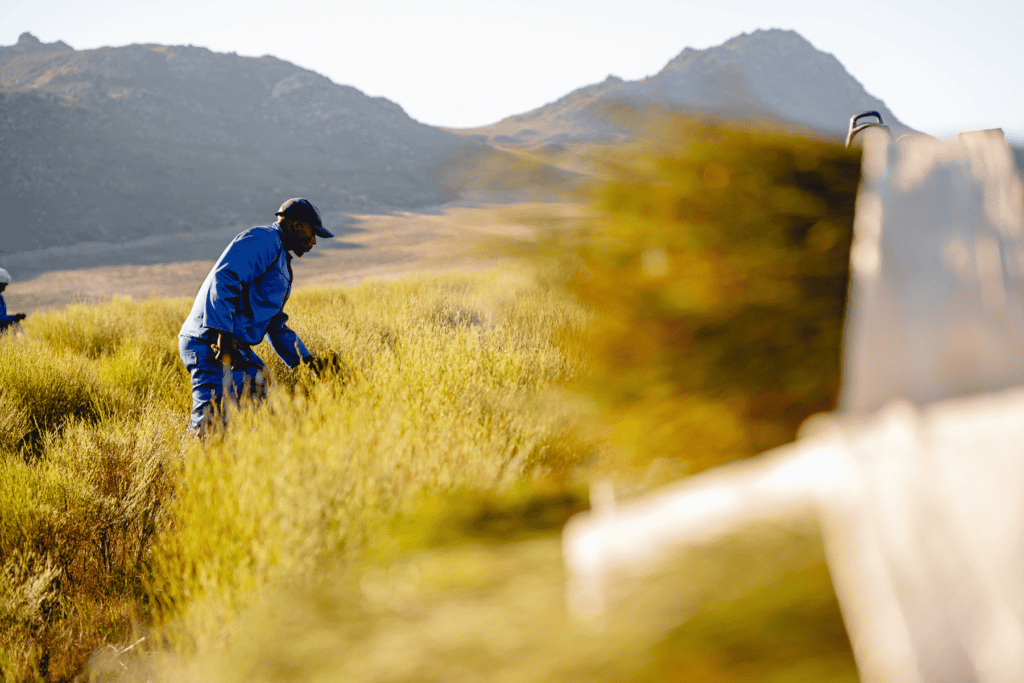
There are few agricultural products in the world whose story is as closely tied to a single landscape as Rooibos.
Grown predominantly in the Cederberg and surrounding regions of South Africa’s Western and Northern Cape, Rooibos (Aspalathus linearis) is a naturally adapted dryland crop. Its relationship with the local climate, soils and seasonal rainfall is part of what makes Rooibos so unique, and why understanding the environment in which it grows is so important to the future of the industry. This year, that environment is giving farmers and the wider Rooibos industry plenty to think about.
South Africa has experienced an exceptionally dry period through parts of the 2026 winter, following significant rainfall earlier in the season (SAWS, 2026). At the same time, a strong El Niño event is developing in the tropical Pacific, with global climate agencies expecting it to strengthen further during the coming months (WMO, 2026a).
But for Rooibos, the important question isn’t simply “Will the weather be dry?”
It is:
How do we build resilience around a crop that is naturally adapted to a challenging environment?
What is El Niño?
El Niño is a naturally occurring climate phenomenon associated with unusually warm sea-surface temperatures in the central and eastern tropical Pacific Ocean.
These changes influence atmospheric circulation and can affect weather patterns far beyond the Pacific. Strong El Niño events have historically been associated with a greater likelihood of warmer and drier conditions across parts of southern Africa, although impacts vary considerably by region and season (NOAA, 2026a; NOAA, 2026b).
The term “Super El Niño” is increasingly being used to describe an exceptionally strong event. Climate agencies generally use measured sea-surface temperature anomalies rather than this informal term. The World Meteorological Organization currently describes the developing 2026 event as a strong El Niño, with forecasts indicating that it could strengthen significantly during August to October (WMO, 2026a).
Importantly, El Niño is a climate signal, not a prediction of a failed Rooibos crop.
Weather varies naturally from year to year. The opportunity is to understand the signals early and use that information to make better decisions.
Why Rooibos is different
Rooibos is remarkably well adapted to its environment.
The plant evolved in the semi-arid Cederberg landscape, where hot, dry summers and cool, wet winters form part of the natural cycle. Its physiology enables it to cope with periods of water limitation and high temperatures (Chimphango et al., 2020; Jordaan et al., 2022).
But adaptation does not mean immunity.
Research indicates that changes in temperature and water availability can influence Rooibos growth and productivity (Chimphango et al., 2020; Lötter and le Maitre, 2014). This makes responsible farming practices particularly important. And importantly, many of the practices that help build resilience are not new responses to El Niño.
They are already part of how we approach Rooibos production at Carmién.
Building resilience starts in the soil
For a dryland crop, the question isn’t simply how much rain falls. It is also how effectively the land can capture, retain and use that water.
At Carmién, we use low-tillage farming practices to minimise unnecessary disturbance of the soil and help maintain soil structure.
We also practise rotational cropping, allowing cultivated areas to recover between production cycles rather than continuously placing pressure on the same land.
Another important part of our approach is returning biomass to the soil. Plant material is worked back into the soil, helping return organic matter and nutrients to the system.
These practices support healthier soils, which in turn can contribute to better water infiltration, moisture retention and long-term soil productivity.
It is not about finding a quick solution to a dry season.
It is about building a healthier farming system over time.
Protecting the landscape around the crop
Our approach also extends beyond the areas we cultivate.
Rooibos is part of the Cape Floristic Kingdom, one of only six floral kingdoms in the world. It is the smallest of the six, and the only one contained entirely within a single country (SANBI, 2012). It is one of the most botanically diverse regions on Earth. This is no ordinary growing region. Its extraordinary concentration of unique plant species makes this landscape truly exceptional – and protecting it is inseparable from protecting the future of Rooibos.
More than 50% of our farming environment remains natural, wild vegetation.
Maintaining natural vegetation alongside cultivated areas helps protect biodiversity and preserve the ecological character of the landscape in which Rooibos naturally occurs.
For us, responsible Rooibos production is therefore not about cultivating every available hectare.
It is about finding the right balance between production and conservation.
Managing water carefully
Rooibos is primarily a rain-fed crop, so water management requires a different approach from intensive irrigated agriculture.
At Carmién, we have water management systems in place to monitor, capture and manage water resources, helping us use available water as efficiently as possible. This becomes particularly important in a Mediterranean climate where rainfall is strongly seasonal (Dzikiti et al., 2022). And water management does not happen in isolation. Healthy soils, natural vegetation and responsible cultivation practices all contribute to how effectively the landscape responds to rainfall.
The objective isn’t to eliminate our dependence on nature.
It is to work intelligently with the environment in which Rooibos grows.
Crop knowledge and close monitoring
One of the greatest advantages of working closely with a crop is the ability to understand what is happening on the ground.
Weather data, seasonal climate forecasts, field observations and crop monitoring all contribute to better decision-making. For Rooibos, this is particularly important because conditions can vary within the same growing region and even between farms.
Farmer experience remains invaluable, while scientific research and climate information provide additional tools to understand what may be coming.
The closer we are to the crop, the better positioned we are to respond.
Planning beyond the farm
Agricultural resilience also extends into the supply chain.
A natural crop will always experience some degree of variability. Even with good farming practices, individual seasons will differ. For international Rooibos buyers, this makes continuity of supply an important consideration. At Carmién, we maintain reserve stock to help provide continuity of supply, creating a buffer between natural agricultural variability and the requirements of our customers. This allows us to plan beyond the immediate harvest and gives our customers greater confidence when planning their own production, packaging and retail programmes.
It is another example of why Rooibos supply resilience needs to be considered across the entire value chain – from the farm, through processing, to the international customer.
The advantage of being close to the crop
At Carmién, we have a particularly direct connection to the agricultural environment.
Our factory is located on a Rooibos farm.
We see the fields, experience the seasons and work alongside the people responsible for producing the crop. That proximity matters. Weather data, crop forecasts and supply figures are valuable, but they tell only part of the story. They need to be combined with what is happening on the ground.
Our location, together with decades of Rooibos experience, gives us a practical understanding of the crop and the environment in which it grows.
From climate risk to climate resilience
We cannot control when the rain falls.
We cannot determine how strong the next El Niño will be.
But we can control how we prepare.
We can protect our soils through low-tillage practices and rotational cropping.
We can return biomass to the land.
We can protect natural ecosystems, with more than half of our environment remaining wild vegetation.
We can manage water responsibly.
We can monitor conditions closely.
And we can maintain reserve stock to help ensure continuity of supply.
None of these measures eliminates climate variability.
Together, however, they create a farming and supply system that is better equipped to manage it. That is what resilience looks like in practice: not one solution, but many good decisions made consistently over time.
For Rooibos, the future depends on protecting more than the crop itself.
It means protecting the land, supporting the people who farm it, maintaining responsible agricultural practices and building supply chains that can adapt to changing conditions. Because when you work with a crop that grows in one very special corner of the world, looking after that corner is everyone’s responsibility.
The climate story doesn’t stop at the farm gate.
For Rooibos, it starts there.
And at Carmién, we’re right in the middle of it.
Sign up for the Newsletter
Enjoyed this insight? Subscribe to our B2B mailing list for market updates, product innovation, and supply intelligence—delivered straight from origin.
References
- Dzikiti, S., Lötter, D., Mpandeli, S. and Nhamo, L. (2022) ‘Assessing the energy and water balance dynamics of rain-fed rooibos tea crops (Aspalathus linearis) under changing Mediterranean climatic conditions’, Agricultural Water Management, 274, 107944. https://doi.org/10.1016/j.agwat.2022.107944
- Lötter, M.C. and le Maitre, D.C. (2014) ‘Modelling the distribution of Aspalathus linearis (rooibos tea): implications of climate change for livelihoods dependent on both cultivation and harvesting from the wild’, Ecology and Evolution, 4(8), pp. 1209–1221. https://doi.org/10.1002/ece3.985
- MacAlister, D., Muasya, A.M., Crespo, O., Ogola, J.B.O., Maseko, S.T., Valentine, A.J., Ottosen, C.-O., Rosenqvist, E. and Chimphango, S.B.M. (2020) ‘Effect of temperature on plant growth and stress tolerant traits in rooibos in the Western Cape, South Africa’, Scientia Horticulturae, 263, 109137. https://doi.org/10.1016/j.scienta.2019.109137
- NOAA (2026a) ‘El Niño and La Niña: Definitions’, National Oceanic and Atmospheric Administration. Available at: https://www.noaa.gov/education/resource-collections/weather-atmosphere/el-nino
- NOAA (2026b) ‘El Niño Temperature and Precipitation Patterns’, Climate Prediction Center, National Oceanic and Atmospheric Administration. Available at: https://www.cpc.ncep.noaa.gov/products/analysis_monitoring/ensocycle/elninosfc.shtml
- South African National Biodiversity Institute (SANBI) (2012) The Core Cape Subregion. Strelitzia 29. Pretoria: South African National Biodiversity Institute. Available at: https://www.sanbi.org/wp-content/uploads/2018/04/strelitzia-29-2012.pdf
- South African Weather Service (SAWS) (2026) Seasonal Climate Watch: June to October 2026. Pretoria: South African Weather Service, 2 June 2026. Available at: https://www.weathersa.co.za/Documents/SeasonalForecast/SCOLF202605_02062026234634.pdf
- World Meteorological Organization (WMO) (2026) Global Seasonal Climate Update for August–September–October 2026. Geneva: World Meteorological Organization. Available at: https://public.wmo.int/resources/publication-series/global-seasonal-climate-update/gscu-aso2026